|

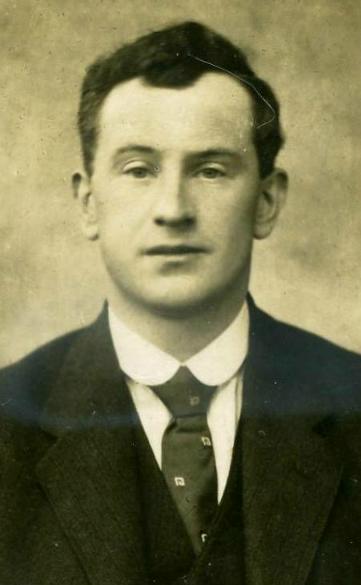
Dietrich Waddington
From Andreas Oehlke, via the guestbook on this site in January
2010:
In 19th century some English textile engineers and fitters helped to establish
the local textile industry in Westphalia/ Germany.
William Waddington (1831 in Oldham - + 1902 in Rheine) from Oldham
came to Rheine in the years of 1865 or 1868 to setup for Platt Broth., Oldham the new spinning mill for C. Kümpers & Timmerman.
He stayed in Rheine after marriage with Friederike Mülder from Schüttorf (Kingdom of Hanover) and worked as a spinning master
for C. Kümpers & Timmerman.
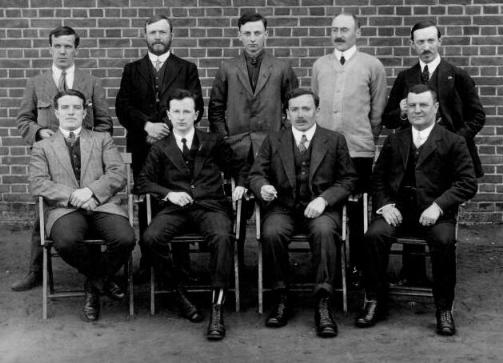
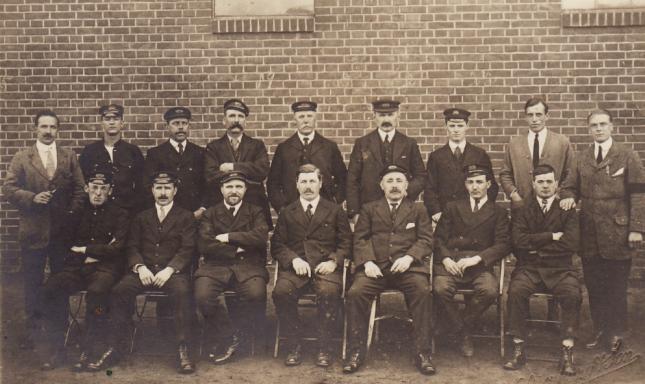
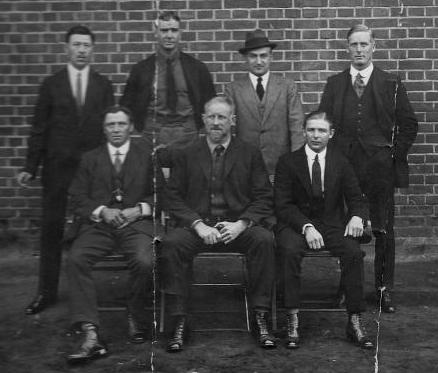
His son Dietrich Waddington, born 1880 in Rheine, went to Platt Brothers, Oldham, in
the years of 1896 to 1902 to became a textile engineer. Back in Rheine he worked for C. Kümpers & Timmerman, C. Kümpers
Söhne and F. A. Kümpers, all textile firms. In 1907 he got the job as technical director of the Gebrüder Kock spinnining mill
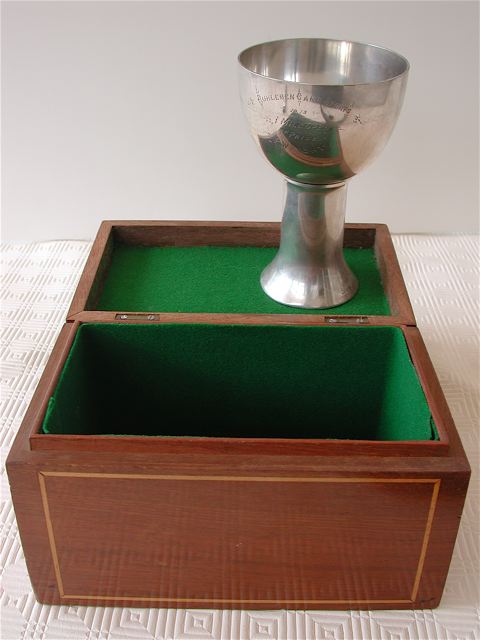
in Borghorst. With the outbreak of the Great War he was interned at Ruhleben after the 6th of November 1914, but was set free
after intervention of the firm owner the Brethren Kock. In the same way Albert Clegg, technical director of the textile firm
Gebrüder Laurentz in Ochtrup (Westphalia), was also interned at Ruhleben and set free after intervention some month ago.
(With thanks to Andreas.)
William Waddington
See Dietrich Waddington.
Frank Wade
|
|
| Wade by Walker (click to enlarge) |
Frank Wade was listed in the third issue of the Ruhleben Camp Magazine
(May 1916, p.43) as having exhibted in the camp's third art exhibition.
In the fourth issue (August 1916, p.32), Wade contributed a drawing entitled
"The Last Voyage of HMS Lion".
Wade was also noted in issue six of the Ruhleben Camp Magazine (June 1917)
as having given an exhibition of humorous drawings in the Studio in Ruhleben in April 1917, alongside fellow artists Robert
Walker and Percy P. Wood.
"The thanks of the Camp are due to the artists whose genuinely funny but unobtrusive
gifts have done so much to show us that there is a humorous side even to Lager life, and it affords us very much pleasure
to put on record these few words of appreciation".
Wade also contributed sketches to the same magazine of a leatherwork
class and a charicature of his colleague, Robert Walker.
Wade was thanked for his illustrations for the Ruhleben Camp Magazine by its editor,
C. G. Pemberton, in the fifth issue (Christmas 1916, p.62).
After the war, The Times of February 5th 1919 also tells us that
the Crown Princess of Sweden returned on February 4th to the Ruhleben Exhibition, and purchased 40 paintings, with the painters
selected including Wade ("Court News", p.11, col. B).
|
|
| Sketch by Wade ("Ruhleben Series") |
Samuel Wagenheim
Samuel Wagenheim is listed in the surviving register from Barrack 5 at Ruhleben (register
number 2), recorded by Neville Stanley Wilkinson in approximately 1916. In the register, Wagenheim is recorded as having
been born on November 19th 1891 in London, and is described as having been a clerk prior to his internment.
His home address was listed as 162 Amhurst Road, Hackney, London, N. At the time the register was recorded, Wagenheim
was noted as staying in loft A, having transferred there from Barrack 12 on May 20th 1915.
William M. Wainwright
William Wainwright is listed in the surviving register from Barrack 5 at Ruhleben (register
number 2), recorded by Neville Stanley Wilkinson in approximately 1916. In the register, Wainwright is recorded as having
been born on February 15th 1896 in Sheffield, and is described as having been a student prior to his internment.
His home address was listed as 36 Glencoe Road, Norfolk Park, Sheffield. At the time the register was recorded, Wainwright
was noted as staying in loft A.
From the handbook of the Ruhleben Football Association Season 1915, Wainwright is noted as being from 36 Glencoe
Road, Sheffield, and as having been born in Sheffield in 1896. He worked as an apprentice in Cologne, where he was arrested
on 5 SEP 1914. After a brief period held in Cologne he was sent to Ruhleben, where he was interned in Barrack 5.
J. Wake
J. Wake was noted in The Times of December 8th 1915 as having been one of
the 160 prisoners released from Ruhleben on the previous day who had travelled by train to Flushing ("Returning Civilians"
p.9, col.F).
Vice-Consul Walker of Lille
The National Archives hold documents from 1915 at FO 383/21 concerning
Vice-Consul Walker of Lille, which detail reports of his arrest and internment at Ruhleben.
Henry E. Walker
The National Archives in London hold documents from 1915 at FO383/26 regarding
Ruhleben inmates Henry E. Walker and H. A. Bell, including an enquiry from Walker's brother, James E. Walker in Paris,
regarding a possible invalid exchange.
A Henry Walker was listed in The Times of January 8th 1916 ("Released Civilians" p.5, col. D) as one
of 69 men released from Ruhleben on Thursday, January 6th, 1916, who subsequently travelled to Flushing for their return
trip to England.
|
|
| Walker by Wade (click to enlarge) |
Robert Walker is noted in issue six of the Ruhleben Camp Magazine (June 1917) as having given an exhibition
of humorous drawings in the Studio in Ruhleben in April 1917, alongside fellow artists Wade and Wood.
"The thanks of the Camp are due to the artists whose genuinely funny but unobtrusive
gifts have done so much to show us that there is a humorous side even to Lager life, and it affords us very much pleasure
to put on record these few words of appreciation".
Walker also contributed a sketch to the same publication entitled "A Wartime Farmer in the Making".
Walker was thanked for his illustrations for the Ruhleben Camp Magazine by its editor, C. G. Pemberton,
in the fifth issue (Christmas 1916, p.62).
The Imperial War Museum in London holds a printed card (1p) designed by Robert Walker depicting the living quarters
of civilian internees at Ruhleben in 1917. It can be found at ID:9496 Misc 60 (915).
Captain Thomas Walker
Captain Thomas Walker was one of the Ruhleben prisoners to sign a message
of greeting to Sir Edward Letchworth, Grand Secretary of English Freemasons, postmarked December 9th 1914, and printed in
the Times of December 28th 1914 (page 3, col. B). The message stated:
"Worshipful Sir & Bro.,
We the undersigned brethren, at present interned with other British civilians
at the concentration camp at Ruhleben - Spandau, Germany, send hearty good wishes to the Grand Master, officers and brethren
in Great Britain, hoping that we may have the pleasure soon of greeting them personally."
Walker was the master of the Aberdeen to hamburg trading steamer "Rubislaw",
and was interned with his crew at the outbreak of war. He did not take to internment well, and when he was released in October
1915, he had spent the previous six months in a sanitorium in West Berlin, having suffered a breakdown brought about by the
privations and insufficiency of the food supply. On October 19th 1915, Walker finally made it back to Aberdeen with other
prisoners after an exchange.
Walker's return was covered by the Scotsman newspaper on October 20th 1915
("Ruhleben Internment Camp", p.7), and in the article the captain gave a description of the poor conditions at the camp.
Charles Walkerley
Charles Walkerley was a fisherman from Boston, Lincolnshire, who was taken
captive in 1914, sent first to Sennelager prison and then on to Ruhleben. He returned to Boston in 1918.
Many thanks to Richard Caville, husband of Charles' granddaughter, for
this information on Charles.
E. Wallworth
E. Wallworth was noted in The Times of December 8th 1915 as having been one of the 160 prisoners released
from Ruhleben on the previous day who had travelled by train to Flushing ("Returning Civilians" p.9, col.F).
John Walmsley
From the handbook of the Ruhleben Football Association Season 1915, we learn that John Walmsley was
from 32 Hereford Road, Wanstead, Essex, and was born in Bolton in 1888. He was a chartered accountant, and was arrested in
Frankfurt on 6 NOV 1914, and was sent to Ruhleben, where he was interned in Barrack 4.
Harry Carter Walsh
Harry Carter Walsh is listed in the surviving register from Barrack 5 at Ruhleben (register number
2), recorded by Neville Stanley Wilkinson in approximately 1916. In the register, Walsh is recorded as having been born
on April 8th 1884 in Bolton, and is described as having been a chartered accountant prior to his internment.
His home address was listed as 28 Swinderby Road, Wembley, Middlesex. At the time the register was recorded, Walsh was
noted as staying in box 14. He relocated to Holland on April 25th 1918.
From the handbook of the Ruhleben Football Association Season 1915, Walsh
is noted as being from 28 Swinderby Road, Wembley, Middlesex, and as having been born in Bolton in 1884. He worked as
a chartered accountant in Elberfeld, where he was arrested on 22 SEP 1914. After a brief period held in Elberfeld
and Duisburg, he was sent to Ruhleben, where he was interned in Barrack 5.
Walsh
was recorded as a member of the Ruhleben Lancastrian Society in the Manchester Guardian of January 15th 1915 (p.12). The article
is entitled "Interned in Germany: Lancashire's Civilian Prisoners: Full List of Those Detained at Ruhleben".
Walsh was also noted as an inmate at Barrack
5 in a Christmas postcard reproduced in Frank Bachenheimer's "A Postal History Study of...The Ruhleben P.O.W. Camp 1914-1918"
(Fig. 31). The card was addressed to Mr. and Mrs. Edward Cooper at 28 Uxbridge Road, Ealing, London, and was posted Christmas
1914. The printed card read:
ENGLANDERLAGER, RUHLEBEN - SPANDAU, GERMANY
XMAS 1914
WISHING YOU A HAPPY XMAS AND A BRIGHTER NEW YEAR FROM
Harry C. Walsh
BRITISH CIVIL PRISONER OF WAR
James Walsh
The National Archives in London hold documents from 1915 at FO383/59 regarding
the death of British Ruhleben inmate James Walsh at Ruhleben, and arrangements for the
disposal of his effects to his brother, G. P. Walsh, residing at Amsterdam.
Edwin Walwork
Edwin Walwork was recorded as a member of the Ruhleben Lancastrian Society
in the Manchester Guardian of January 15th 1915 (p.12). The article is entitled "Interned in Germany: Lancashire's Civilian
Prisoners: Full List of Those Detained at Ruhleben". His address was recorded as Bantock, Poulton-le-Fylde, Preston.
Albert Warburton
Albert Warburton was recorded as a member of the Ruhleben Lancastrian Society in the Manchester Guardian
of January 15th 1915 (p.12). The article is entitled "Interned in Germany: Lancashire's Civilian Prisoners: Full List of Those
Detained at Ruhleben". His address was recorded as 3 Davenstedterstrasse, Hanover (of Elton, Bury).
Andrew Warburton
Andrew Warburton was one of sixteen men released from Ruhleben in January 1917, as reported in
the Times of January 29th 1917 ("Changed Conditions in Germany", p.8, col. G).
David Warburton
David Warburton was recorded as a member of the Ruhleben Lancastrian Society in the Manchester Guardian
of January 15th 1915 (p.12). The article is entitled "Interned in Germany: Lancashire's Civilian Prisoners: Full List of Those
Detained at Ruhleben". His address was recorded as 4 Littenberg Platz, Hanover.
Ernest Warburton
Ernest Warburton was a professional golfer interned in Ruhleben. He was a member of Keil Golf Club
in 1905. Many thanks to David Hamilton at St Andrews for supplying this information.
From the handbook of the Ruhleben Football Association Season 1915, we learn that Warburton was
from Dunhome Morsey near Altrinkam in Cheshire, and was born March 7th 1882. He was a professional golfer, arrested in Kiel
on November 6th 1914 and sent to Ruhleben, where he was interned in Barrack 2.
Ward
The National Archives hold records from 1915 at FO383/77 regarding a Mrs
F. H. Ward, of Catford, the wife of a British subject interned in Ruhleben. The documents are a request
for assistance following the discontinuance of relief from the National Relief Fund. This may be the same ward as listed
below.
G. W. Ward
G. W. Ward was one of the Ruhleben prisoners to sign a message of greeting to Sir Edward Letchworth,
Grand Secretary of English Freemasons, postmarked December 9th 1914, and printed in the Times of December 28th 1914 (page
3, col. B). The message stated:
"Worshipful Sir & Bro.,
We the undersigned brethren, at present interned with other British civilians
at the concentration camp at Ruhleben - Spandau, Germany, send hearty good wishes to the Grand Master, officers and brethren
in Great Britain, hoping that we may have the pleasure soon of greeting them personally."
Henry Gordon Ward
Henry Gordon Ward is listed in the surviving register from Barrack 5 at Ruhleben (register number
2), recorded by Neville Stanley Wilkinson in approximately 1916. In the register, Ward is recorded as having been born
on April 27th 1880 in London, and is described as having been a college lecturer prior to his internment.
His home address was listed as 283 Eastern Road, Brighton. At the time the register was recorded, Sutherland was
noted as staying in box 22.
The National Archives in London hold documents
from 1916 at FO383/206 concerning an enquiry from a Mr. Ward about his son, Henry Gordon Ward, held as a prisoner in
Ruhleben.
S. A. Ward
S. A. Ward was noted on a list of prisoners of
war on a document entitled 'Men in Englander Lager, Ruhleben', held by Hull Local Studies Library (provisional catalogue entry: Hohenrein Collection F 10b), supplied by senior local studies librarian
David Alexander Smith in July 2008, for which I am grateful. The document
notes that Ward was a civilian interned in Barrack 13.
Edward Waring
Edward Waring is listed in the surviving register from Barrack 5 at Ruhleben (register number
2), recorded by Neville Stanley Wilkinson in approximately 1916. In the register, Waring is recorded as having been born
on April 17th 1865 in Sheffield, and is described as having been a works manager prior to his internment.
His home address was listed as Attercliffe, Sheffield. At the time the register was recorded, Waring was noted as
staying in box 17. He returned to England on March 7th 1918.
The National Archives in London hold documents
from 1915 at FO383/55 regarding Mr. E. Waring, a British subject employed in Germany, who was subsequently interned at Ruhleben, regarding a claim by him for compensation for financial losses, and a request for a monthly
allowance for his family back in Sheffield.
Walter Waring
Walter Waring is listed in the surviving register from Barrack 5 at Ruhleben (register number
2), recorded by Neville Stanley Wilkinson in approximately 1916. In the register, Waring is recorded as having been born
on May 12th 1889 in Sheffield, and is described as having been a moulder prior to his internment. His home
address was listed as 66 Leeds Road, Attercliffe, Sheffield. At the time the register was recorded, Waring was noted
as staying in box 17. He is believed to be the son of Edward Waring (above).
From the handbook of the Ruhleben Football Association Season 1915, Waring is noted as being from 66 Leeds
Road, Attercliffe, Sheffield, and as having been born in Sheffield in 1889. He worked as a steel worker in Crefeld, where
he was arrested on 5 SEP 1914. After a brief period held in Crefeld and Duisburg, he was sent to Ruhleben, where
he was interned in Barrack 5.
William Warne
William Warne was a British jockey working in Hoppegarten, who was interned in Ruhleben at the
beginning of November 1914, as noted in the Scotsman newspaper on 9/11/1914 (p.9), and in The Times of the same day ("British
Interned in Germany", p. 7, col. E).
In April 2008, I received the following from Jochem Weicke, to whom I am indebted:
William Warne was over the top of his career in 1914 with 7 wins out of 96 rides.
W. Warne 1888 1000 Guines in England. Riding in Germany since 1891 he got 3x St.Leger and the Derby in 1909 for Graditz
and trainer Reg Day.
In May 2008 I was also contacted by Doug Johnson with some additional information on Warne, for which
I am grateful:
Correspondence
with the United States Ambassador respecting the Treatment of British Prisoners of War and Interned Civilians in Germany Miscellaneous
No 14 (1915) (Cd 7959) HMSO
Two other jockeys from Hoppergarten,
William Warne and jockey Aylin, are both land proprietors in Germany. Warne
owns real estate to the value of 100,000 M., and Aylin to the value of 40,000 M. Warne
is a resident of Germany for twenty years, and formerly lived
in Austria. Aylin
has been in Germany for the last ten years, and formerly domiciled
in Austria. Both
are married, Aylin to a German Woman
Further information on Warne was posted on this site's guest book, by his
great niece's husband John Constable in Bishop Auckland in September 2010:
My wife and I were fascinated to read
of the internment of her great uncle William Warne the famous jockey. We knew so little, however we can confirm that he did
survive the ordeal of Ruhleben as we have an orginal centrefold of the Daily Mirror dated 13th October 1924 in which there
is a photograph taken at Newmarket including Willie under the title "Old Time Jockeys". Thanks for the info your site has
provided.
C. P. Warner
C. P. Warner was thanked for articles written for the Ruhleben Camp Magazine by its editor, C. G.
Pemberton, in the fifth issue (Christmas 1916, p.62).
L. P. Warner
L. P. Warner was interned in Barrack 8 and is noted as playing on the
England side, led by Steve Bloomer, in a mock international between England and the Rest of the World on May 2nd 1915.
Kick off took place at 4.30pm, and a document with the teams listed was recently discovered amongst some Foreign Office files
by the National Archives, in November 2005.
Warner was noted in the second issue of the Ruhleben Camp Magazine (April 1916,
p. 29) as having been the referee of a football match between teams led by John Cameron and Steve Bloomer on March 3rd
1916, Cameron's side winning.
Warner played for the barrack football team against Barrack 20 in the RFA cup final in April 1917,
as noted in the sixth issue of the Ruhleben Camp Magazine (June 1917). The first match was a draw, 1-1. In the replay, three
days later, Barrack 8 lost, 3-0.
Warner was also noted on a list of prisoners of war on a document entitled 'Men in Englander Lager,
Ruhleben', held by Hull Local Studies Library (provisional catalogue entry: Hohenrein Collection F 10b), supplied by senior local studies librarian
David Alexander Smith in July 2008, for which I am grateful. The document
notes that he was a civilian, and interned in Barrack 8.
William Walter Brooks Warner
The National Archives in London hold documents from 1915 at FO383/26
and FO383/27 regarding the release for treatment of W. W. B. Warner, an incapacitated British subject in the camp, and former
superintendent of the Eastern Telegraph Company.
John Warr
John Warr was named in an undated Foreign Office document
contained within file FO 369/710, entitled Russenlager Ruhleben (Ruhleben Russian Camp), implying it was compiled at the outbreak
of internment in 1914. He was described as a 26 year old chemist previously at work in Berlin.
Simply as Warr he is further noted in another document
in FO 369/710 as having been sent to Ruhleben on 9 SEP 1914. He had been residing at 23 Nassauischestrasse in Berlin.
The information was originally compiled by the American Embassy in Berlin.
Warr was also named in a list in FO 369/710 dated 11 OCT 1914, as communicated to the Foreign
Office by a Nurse Coe (with thanks to Simon Fowler).
As J. Warr he was recorded as a member of the Ruhleben Lancastrian Society in the Manchester Guardian
of January 15th 1915 (p.12). The article is entitled "Interned in Germany: Lancashire's Civilian Prisoners: Full List of Those
Detained at Ruhleben". His address was recorded as Moorgate, Staleybridge.
Warren
Warren was noted in the fifth issue of the Ruhleben Camp Magazine (Christmas 1916, p.58) as having
played for the losing A side in a second division match between the A team and the B team on October 3rd 1916. The score
was B: 4 to A: 1.
John Wassenaar
The National Archives in London hold documents from 1915 at FO383/60 regarding
the death of John Wassenaar, formerly a British teacher at Cassel, who was interned at Ruhleben
and who subsequently died at Dr Weiler's Sanatorium. The documents contain a report of the circumstances and his
funeral, and details of arrangements for the return of his property.
Eric Watkins
The son of Harry Watkins - see below.
Harry Watkins
Harry Watkins is listed in the surviving register from Barrack 5 at Ruhleben (register number
2), recorded by Neville Stanley Wilkinson in approximately 1916. In the register, Watkins is recorded as having been
born on January 28th 1873 in London, and is described as having been a theatre decorator prior to his internment.
His home address was listed as 5 Hochmeisterstr., Berlin, N. At the time the register was recorded, Watkins was
noted as staying in loft B, having transferred there from Barrack 1 on April 19th 1915.
In January 2007, Harry's great granddaughter Helen Hayes sent the following in an e-mail:
My great grandfather Harry Watkins & my grandfather Eric Watkins (who was around 17 years)
were civilians in the camp. Harry married Louisa Marie Josephina Adele Rossins who we think was German, or as the
story goes & this is the reason they where in the camp. (they did escape but do not know when). Harry & Louisa married
in England in 1903 but that's all I know of Louisa. Harry & Eric were both artists. I have a programme from
the camp, of Cinderella dec 27th 1915, Harry Watkins was one of the scenery painters, also a Christmas 1916 programme The
Mikado by Gilbert & Sullivan.
I also have paintings done by Harry where story goes were not done with paint, but
the colours from the ground/plants.
Many thanks to Helen.
T. W. Watkins
T. W. Watkins, of Wareham, was named in a list of merchant seamen interned at Ruhleben, as published
by the Scotsman newspaper on 7/1/1915 (p.7).
B. Watson
B. Watson, of Seaham Harbour, was named in a list of merchant seamen interned at Ruhleben, as published
by the Scotsman newspaper on 7/1/1915 (p.7).
Fred Watson
Fred Watson was recorded as a member of the Ruhleben Lancastrian Society in the Manchester Guardian
of January 15th 1915 (p.12). The article is entitled "Interned in Germany: Lancashire's Civilian Prisoners: Full List of Those
Detained at Ruhleben". His address was recorded as 116 Berlington Avenue, Oldham.
Fred Watson
From the handbook of the Ruhleben Football Association Season 1915, Fred Watson was noted
as being from Maisie House, Rawcliffe Bridge, and as having been born in 1894. He worked as a mariner and was arrested
in Hamburg on 16 OCT 1914. After a brief spell imprisoned on the hulks in Hamburg, he was sent to Ruhleben, where he
was interned in Barrack 8.
Marcus Bateman also notes from TNA files in MT9/1238 that Watson was a cook on the Winterton.
Murray Watters
The National Archives holds documents from 1915 at FO383/26 regarding Murray
Watters, including correspondence for his sister, Mrs MacRae of Edinburgh, and later correspondence regarding his death,
presumably in Ruhleben.
Captain Edwin J. Wattley
The National Archives in London hold documents from 1915 at FO383/27 regarding
Captain Edwin J. Wattley, the former master of the SS Oswestry, aged over 60 years of age and interned in Ruhleben.
They specifically deal with an enquiry from Messrs Sivewright, Bacon and Co regarding his possible release, following
the case of Henry Karle of Manchester, and include a newspaper extract to this end (in docket no.176395).
James William Watts
From the handbook of the Ruhleben Football Association Season 1915, we learn that James William
Watts was resident at 100 Grove Park, Camberwell, was a tailor arrested in Hamburg on 6 NOV 1914, and after a brief
stint on the hulks in Hamburg, was sent to Ruhleben, where he was interned in Barrack 1.
Oscar Watts
From this site's guestbook, a post by Andrew Longridge in December 2010:
I would like to add my grandfathers name
to the list of prisoners on the Ruhleben site. His name was Oscar Watts and was interned from the ship Sappho 111305 along
with the rest of the crew. The only other ship crew member listed is G. Meadows who was released 7/3/1918. I have several
photographs of my grandfather inside the camp. He was an able seaman and home address Frampton, Stonehouse, Gloucestershire.
After the war he built a railway carriage home (still lived in) and later that's when I came in as I lived with my grandparents.
I feel he should be listed and remembered on the prisoner list.
Oscar's presence at Ruhleben is confirmed in the MT9/1238 records at the
National Archives - he was an able bodied seaman on the Sappho (with thanks to Marcus Bateman).
Arthur Waudby
Arthur Waudby is listed in the surviving register from Barrack 5 at Ruhleben (register number
2), recorded by Neville Stanley Wilkinson in approximately 1916. In the register, Waudby is recorded as having been born
on February 8th 1868 in Hull, and is described as having been a groom prior to his internment. His home
address was listed as Acomb, Yorkshire. At the time the register was recorded, Waudby was noted as staying in box
11. He returned to England on January 2nd 1918.
Alec Waugh
Alec Waugh was a British horse trainer working in Hoppegarten, who was interned in Ruhleben
at the beginning of November 1914, as noted in the Scotsman newspaper on 9/11/1914 (p.9), and in The Times of the same day
("British Interned in Germany", p. 7, col. E).
In April 2008 I received the following additional notes from Jochem Heicke in Germany, to
whom I am extremely grateful:
The Waugh brothers are said to be descendants of Rob Roy, if the
biography of their grandfather James Waugh, a respected trainer of horses in the U.K. and on the continent is right. Their
sister Lucy Waugh was married to trainer Edward Chapman who was also interned with his brother H.Chapman. Their sister Nellie
Waugh was married to Hermann the brother of Christine Althoff, wife of George Arnull. Maria Althoff, sister of them was married
to James William Waugh.
Percy Waugh became a trainer in Denmark and won the Scandinavian Derbies in
1935 when his cousin Frank Butters had unbeaten Derby winner Bahram in England and his cousin George Arnull had Sturmvogel
the German Derby winner that year.
(My family is a little bit involved as Sturmvogel was ridden by my father's
uncle, whose uncle had been apprenticed to James Waugh and Manfred Chapman grandson of Lucy Waugh succeeded my father as racing
commentator in Germany).
R.A. Waugh was soon released to train horses in Hoppegarten
Alec (button #94) and Percy Waugh were brothers and sons of former Graditz
trainer Richard Waugh. Their married brother James William, born 1884 in Graditz #130 trained under condition.
Percy Waugh
Percy Waugh was a British horse trainer working in Hoppegarten, who was interned in Ruhleben
at the beginning of November 1914, as noted in the Scotsman newspaper on 9/11/1914 (p.9) , and in The Times of the same day
("British Interned in Germany", p. 7, col. E).
Richard Alexander Waugh
Richard Alexander Waugh was a British horse trainer working in Hoppegarten, who was interned
in Ruhleben at the beginning of November 1914, as noted in the Scotsman newspaper on 9/11/1914 (p.9), and in The Times of
the same day ("British Interned in Germany", p. 7, col. E).
From Jochem Weiche:
Richard Alexander Waugh was born Roxburgh, Scotland 8 Nov 1869, and died
at Hoppegarten 26 Nov 1930. He was the cousin of the father of Alec and Percy Waugh, and having been orphaned at the age of
8, grew up with his uncle James in Austria. He was released and trained under condition.
G. Weadwood
G. Weadwood, of West Hartlepool, was one of fifteen men released from Ruhleben who arrived in neutral
Holland on June 7th 1916, as noted in the Times of June 8th 1916 ("War Weariness in Germany", p.7, col.C).
Weathers
Weathers was one of the Ruhleben prisoners to sign a message of greeting to Sir Edward Letchworth,
Grand Secretary of English Freemasons, postmarked December 9th 1914, and printed in the Times of December 28th 1914 (page
3, col. B). The message stated:
"Worshipful Sir & Bro.,
We the undersigned brethren, at present interned with other British civilians
at the concentration camp at Ruhleben - Spandau, Germany, send hearty good wishes to the Grand Master, officers and brethren
in Great Britain, hoping that we may have the pleasure soon of greeting them personally."
His initials are not clear, but his name may be H. H. Weathers.
Charles Henry George Weber
Charles Henry George Weber was noted in the second
issue of In Ruhleben Camp as having been voted onto the committee of the newly formed Ruhleben Music Society, at a meeting
on Thursday June 15th, attended by some 36 musicians in the camp (p.11 & p.41).
In the first issue of the Ruhleben Camp Magazine (March 1916, p.26), Weber is noted as having given performances of Tschaikovsky's
"Serenade" and Saint Saens' "Danse Macabre".
In the musical notes section of the fourth issue of the Ruhleben Camp Magazine (August 1916, p.25), the following notes
a forthcoming contribution by Weber:
Orchestra concerts will be given on every third Sunday, the intervening Sundays being devoted
to chamber and vocal and instrumental recitals. The first three Symphony Concerts will be conducted by Messrs. Bainton, Weber
and Macmillan, among the works promised being Schumann's Pianoforte Concerto (with Mr. Lindsay as soloist), and Mozart's Symphony
in E. flat.
Weber is further listed in
the same issue as to soon be giving a lecture for the Arts and Science Union:
The present arrangements include two lectures by Mr. Short on the Development
of Chamber Music, with musical illustrations on each occasion, while Mr. Leigh Henry, Mr. Hunt and Mr. Weber are respectively
undertaking similar evenings on works of Debussy, MacDowell and Verdi. A further example of
Weber's musical contribution to life in the camp was noted in issue six of the Ruhleben Camp Magazine (June 1917):
"The gradual improvement of the orchestra under the splendid training of such
fine musicians as Mr. Peebles Conn, Mr. McMilland and Mr. Weber paved the way for the regular orchestral concerts which have
proved such a welcome feature of our captivity."
Weber passed away in 1954, and his obituary was carried in The
Times of July 29th 1954 ("Obituary", p.8, col. E):
OBITUARY
MR. CHARLES WEBBER (sic)
Mr. Charles Webber, for many years conductor of the Royal Carl Rosa Opera Company,
died in hospital in London yesterday at the age of 79.
Charles Henry George Webber was born in London and was eductaed at Leipzig. He later
went to Dresden, where for three years he was a coach under Schuch. He conducted at Chemnitz and Lubeck, and when war broke
out in 1914 he was interned in Germany. He recalled that one of his greatest triumphs in that period was in singing the role
of the Mikado at the internment camp at Ruhleben, with Sir Ernest MacMillan conducting. When he returned to England he joined
the Carl Rosa Opera Company and remained with the company for many years. He also conducted at Covent Garden, and broadcast
on several occasions. He proved himself to be an admirable coach, especially in German opera, and a conductor who could encourage
the artists under his direction to their best endeavours.
A.
Webster
A. Webster is noted on a list of prisoners of war on a document entitled 'Men in Englander
Lager, Ruhleben', held by Hull Local Studies Library (provisional catalogue entry: Hohenrein Collection F 10b), supplied by senior local studies librarian
David Alexander Smith in July 2008, for which I am grateful. The document
notes that Webster was a merchant seaman on board the S. S. Hull, and interned in Barrack 8.
Marcus Bateman's merchant seamen POW site lists Webster as having been resident at 4 Wharum Street, Hull, as a fireman
on board the S. S. Hull, and as released from the camp on March 7th 1918.
Arthur
Webster
Arthur Webster was recorded as a member of the Ruhleben Lancastrian
Society in the Manchester Guardian of January 15th 1915 (p.12). The article is entitled "Interned in Germany: Lancashire's
Civilian Prisoners: Full List of Those Detained at Ruhleben". His address was recorded as 64 Devonport Avenue, Withington.
W. Webster
W. Webster was recorded as a member of the Ruhleben Lancastrian Society in the Manchester
Guardian of January 15th 1915 (p.12). The article is entitled "Interned in Germany: Lancashire's Civilian Prisoners: Full
List of Those Detained at Ruhleben". His address was recorded as 78 Chatsworth Avenue, Orrell Park, Liverpool.
Wechsler
Wechsler was noted in the first issue of the
Ruhleben Camp Magazine (March 1916) as soon to be give a lecture to the M.E.A. Circle entitled "Oxi-Acetylene Welding".
Wechsler is also noted as having stayed in Barrack 6 on a postcard dated 22 FEB 1916 (with
thanks to Dr. Manfred G. Heber in Grand Canaria, who holds a photocopy in his collection).
Charles Weickert
Charles Weickert was one of nine men released from Ruhleben in January 1917, as reported in the Times
of January 12th 1917 ("Nine Prisoners Released from Ruhleben", p.5, col. B).
Mathilde Weidig
The National Archives in London from 1915 at FO383/76 regarding Mathilde
Weidig, the German born wife of naturalised British subject Edward Weidig, interned at Ruhleben,
who had been held at Rotterdam and was wishing to proceed to the U.K. to her German aunt, Mrs. Wilhelmina Motter of Hackney
Wick. The request was considered and the refused.
John Weijacko
John Weijacko was one of nine men over the age of 55 released from Ruhleben at the beginning of May
1916, as noted in the Times of May 9th 1916 ("British Prisoners from Germany", p.5, col.F).
Weinberg
Weinberg was in the Barrack 20 football team at Ruhleben, and according to issue six of the Ruhleben
Camp Magazine (June 1917) played in the cup final in April 1917. The first leg was a scoreless draw, and in the rematch three
days later, Barrack 20 won, 3-0.
A. Weinberg
A. Weinberg advertised in the second issue of In Ruhleben Camp (June 1915, p.16):
A. Weinberg, Bar 6, Box 14, Watchmaker
Weiss
Weiss was noted as playing on the Rest of the World side, led by Cameron, in a mock international
between England and the Rest of the World on May 2nd 1915. Kick off took place at 4.30pm, and a document with the teams listed
was recently discovered amongst some Foreign Office files by the National Archives, in November 2005.
W. Welcome
W. Welcome was noted in the first issue of the Ruhleben Camp Magazine (March 1916)
as soon to be giving a lecture to the M.E.A. Circle entitled "Propellers".
It was obviously a favoured topic of his, for Welcome is again listed in the Nautical Notes section
of the sixth issue of the Ruhleben Camp Magazine (June 1917) as having recently given a "very practical and instructive lecture"
on the workings of the screw propeller.
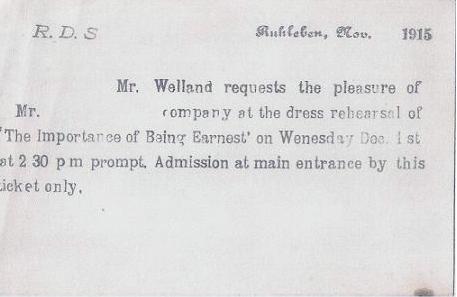
Ralph Archibald Welland
Ralph Archibald Welland is listed in the surviving register from Barrack 5 at Ruhleben (register
number 2), recorded by Neville Stanley Wilkinson in approximately 1916. In the register, Welland is recorded as having
been born on February 5th 1888 in London, and is described as having been an engraver prior to his internment.
His home address was listed as 20 Isledon Road, Holloway, London, N. At the time the register was recorded, Welland was
noted as staying in box 16. He transferred to Barrack 2 on January 2nd 1918.
Welland is noted in the first issue of The Ruhleben Camp Magazine (March
1916, p.8) as having appeared in the play "The Great Adventurer" in the camp.
He is further noted in the fourth issue of the magazine (August 1916, p.34) as having produced the play "Milestones".
The season closed well. We are happy to have this opportunity of congratulating
Mr. Welland and his cast on their successful production of "Milestones". They handled a tall proposition with great energy
and skill. The scenic possibilities of the play were realised to the full, the cast well chosen and very thoroughly trained,
the movement controlled with a precision that gave the action a very clear outline. The players without exception did extremely
well, acting with unusual confidence and charm.
Welland is further noted in issue six of the Ruhleben Camp Magazine (June 1917) as having produced the plays
"Lady Windermere's Fan" and "The Merry Wives of Windsor" whilst in the camp.
Welland also had the honour to be lampooned by way of a monogram drawn
in the same publication by artist CMAW.
Benjamin W. Wenman
The Liddle Collection of Leeds University holds various items on former inmate Benjamin W. Wenman,
under reference RUH 57. These are a letter to a Mr. Chester from J. White, dated November 2nd 1914;
typescript extracts regarding conditions in POW camps, from 1914 to 1918; four letters from Warings Factories, from November
13th 1914 to January 20th 1916; a supplement to the 'Ruhleben Daily News' (June 1915); a letter in German dated february
17th 1915; an issue of 'The Ruhleben Camp Magazine' (June 1917); four pamphlets 'The Ruhleben Prisoners: The Case for
their Release, 'The Ruhleben Prisoners: A Reasoned Plea for Immediate Release, Pamphlet No. 2' and 'The Ruhleben Prisoners:
The Government Attitude, Pamphlet No. 3' (1917), 'The Ruhleben Prisoners: Some Recent Parliamentary References, Pamphlet No.
4' (1917); a Ruhleben Exhibition catalogue from 1919; eleven postcards from January 27th 1917; two Christmas cards
from 1917; two photographs; a wallet, inscribed with 'Prisoner of War Ruhleben Camp 1914/16' and containing a postcard
and a receipt dated July 16th 1918; a French vocabulary book from 1917; a manuscript diary covering August
4th 1914 to September 16th 1915; an open letter from the Ruhleben Prisoners' Release Committee, dated february
8th 1917; a fragment of a note in French; a seat reservation for a demonstration in London relating to British Civil Prisoners
of War on February 26th 1917); a programme of a demonstration in London relating to British Civil Prisoners of War on
February 26th 1917; an off-print from 'The Daily Mail', dated November 6th 1917; a receipt dated October 14th 1918; and a
letter to W. E. Swale, dated April 19th 1978.
The online index tells us that Wenman resided in Barrack 2 whilst in Ruhleben.
Alick West
Alick West was noted as a former inmate at Ruhleben in his obituary in
The Times of July 20th 1972 ("Mr. Alick West", p. 18, col. F).
"Born in 1895 of a strongly religious family, he was educated at Highgate School.
Early in 1914 he went to Germany, meaning to enter Balliol College in the autumn to read classics. In August he was interned
in Ruhleben Camp for the duration of the War..."
Frank E. West
Frank was noted in the first issue of The Ruhleben Camp Magazine (March 1916, p.8) as having
appeared in the play "The Great Adventurer" in the camp.
West was thanked in the fifth issue of the Ruhleben Camp Magazine (Christmas 1916, p.37)
for his contribution to the theatre during 1916.
A postcard from Frank West, written to his wife in German on February 22nd 1918, was reproduced in
Frank Bacchenheimer's "A Postal Study of... The Ruhleben P.O.W. Camp 1914-1918" (Fig 6.4). Mrs West was resident at 42 Hemingford
Road, London N1.
Additional correspondence held by Dr Manfred G. Heber in Grand Canaria lists Frank E. West as being in Barrack 7
Box 10. The correspondence, all sent to London, is dated 25 AUG 1916 (letter), 24 JAN 1917 (letter), 13 APR 1917 (postcard),
27 SEP 1917 (letter), 23 MAY 1918 (letter) and 18 OCT 1918 (letter). (With thanks to Dr Heber).
G. West
G. West was noted on a list of prisoners of war on a document entitled 'Men in Englander Lager, Ruhleben', held by Hull Local Studies Library (provisional catalogue entry: Hohenrein Collection F 10b), supplied by senior local studies librarian
David Alexander Smith in July 2008, for which I am grateful. The document
notes that West was a merchant seaman on board the Euclid, and interned in Barrack 17.
John West
John West was named in an undated Foreign Office document contained
within file FO 369/710, entitled Russenlager Ruhleben (Ruhleben Russian Camp), implying it was compiled at the outbreak of
internment in 1914. He was described as a 19 year old student previously at
work in Berlin.
He is likely to be the West listed elsewhere in a file
in FO 369/710 dated 11 OCT 1914. The name was included in a list communicated to the Foreign Office by a Nurse Coe (with
thanks to Simon Fowler).
Joseph R. Weston
The National Archives in London hold documents from 1915 at FO 383/22 on
the possible exchange of John Herbert Spottiswoode and Joseph R. Weston, British subjects interned at Ruhleben.
J. Wheeler
J. Wheeler noted on a list of prisoners of war on a document entitled 'Men in Englander Lager, Ruhleben',
held by Hull Local Studies Library (provisional catalogue entry: Hohenrein Collection F 10b), supplied by senior local studies librarian
David Alexander Smith in July 2008, for which I am grateful. The document
notes that Wheeler was a merchant seaman on board the Duke of Wellington, and interned in Barrack 17.
C. M. A. Whitaker
C. M. A. Whitaker was thanked for his illustrations for the Ruhleben Camp Magazine by its editor,
C. G. Pemberton, in the fifth issue (Christmas 1916, p.62).
Arthur J. White
From the handbook of the Ruhleben Football Association Season 1915, Arthur
J. White is noted as being from Ilford in Essex, and as having been born in London in 1889. He was a marine engineer (MEA)
and was arrested 2 AUG 1914 and after a brief period held on the hulks was sent to Ruhleben, where he was interned
in Barrack 4.
Boy White (aka Boy Wyte)
Boy White was named in an undated Foreign Office document contained
within file FO 369/710, entitled Russenlager Ruhleben (Ruhleben Russian Camp), implying it was compiled at the outbreak of
internment in 1914. He was described as a 25 year old actor who had been working in Berlin.
Boy White is also noted in a document in FO 369/710 as a 22 year old English cinema
actor (kinoschauspieler) sent first to Berlin's Stadtvogtei on 21 AUG 1914 and then to Ruhleben on 9 SEP 1914. He
had been residing at 13 Schlegelstrasse in Berlin. The
information was originally compiled by the American Embassy in Berlin.
As Boy Wyte he is also listed as being at Ruhleben in
another file in FO 369/710 dated 11 OCT 1914. The list was communicated to the Foreign Office by a Nurse Coe (with
thanks to Simon Fowler).
George White
George White, of 167 Fountain Road, Kirkdale, Liverpool, was a fireman on
board the Borderland, which was captured by a German torpedo boat and escorted into the port of Hamburg, from where after
an initial stay on board their vessel, they were removed and sent to Ruhleben. White was released in January 1918, and a short
interview with him appeared in the Scotsman newspaper on January 9th 1918, where he described his capture and the conditions
of life at the camp ("Lfe in Ruhleben - Stories of Returned Civil Prisoners", p.5).
H. W. White
H. W. White was one of the Ruhleben prisoners to sign a message of greeting to Sir Edward Letchworth,
Grand Secretary of English Freemasons, postmarked December 9th 1914, and printed in the Times of December 28th 1914 (page
3, col. B). The message stated:
"Worshipful Sir & Bro.,
We the undersigned brethren, at present interned with other British civilians
at the concentration camp at Ruhleben - Spandau, Germany, send hearty good wishes to the Grand Master, officers and brethren
in Great Britain, hoping that we may have the pleasure soon of greeting them personally."
J. White
J. White is listed in the sixth issue of the Ruhleben Camp Magazine (June 1917) as co-craftsman
responsible for a clock and inlaid box photographed for the publication as an example of camp craftsmanship, his colleague
being A. E. Licence.
Letham Kay White (1897 - 1950)
|
|
| Letham photographed in 1922 (click to enlarge) |
Letham Kay White was the son of Councillor White of Edinburgh Town Council,
and was interned at Ruhleben after being arrested whilst on his summer holidays in 1914. White continued his education whilst
in Ruhleben, and was noted in issue six of the Ruhleben Camp Magazine (June
1917) as having satisfied the examiners at the London Matriculation Examination, held in the camp in December 1916. The Scotsman
newspaper had previously reported the achievement on February 7th
1917 ("British Prisoners in Germany", p.5).
In addition to the information above, the following short biographical
entry was supplied by Letham's daughter, Kay White, in January 2006, for which I am extremely grateful!
Kay can be contacted at kaywhite@tesco.net.
My father, having left the Royal High School in Edinburgh
aged 17, went to Germany in order to learn German. At that time, there was a compulsory paper in German to get a degree in
engineering. He was interned throughout the time there did not hinder a good education and career. war in Ruhleben POW camp.
During that time he did learn the language, but also learnt the art of sketching from fellow prisoners C.M.Horsfall and Healey
Hislop.
After the war he graduated with a first class honours
degree in civil engineering with the gold medal, and then went abroad in the oil industry. Initially during the twenties in
Burma with the Burmah oil company (where he married my mother in Rangoon) and then during the thirties in Trinidad as Field
Manager of TPD. He was in charge of producing the oil, building roads, building bungaloes, supplying water, just about everything.
Even the Home Guard during WW2.
Unfortunately he died aged 53 and never
talked about his experiences during the captivity.
Moresby White
Moresby White was noted in the second issue of In Ruhleben Camp (June 1915,
p.22) as being the captain of the losing Scottish side of the rugby international between the Scots-Colonials and the
Welsh.
White was thanked for articles written for the Ruhleben Camp Magazine by its editor, C. G. Pemberton,
in the fifth issue (Christmas 1916, p.62).
Sandy White
Sandy White was noted in the second issue of In Ruhleben Camp (June 1915,
p.22) as being one of the forwards on the losing Scottish side of the friendly international between the Scots-Colonials and
the Welsh.
William A. White
The National Archives in London hold documents from 1915 at FO383/26 on
William A. White, namely an enquiry from his wife, Mrs. Clara A. White of Gloucester.
A. Paget Whitehead
From the handbook of the Ruhleben Football Association Season 1915, we
learn that Paget Whitehead was previously resident in 41 Chilton View, North Shields, was born in South Shields
in 1887, and was a ship's officer arrested in Hamburg and after a period of being interned on the hulks, was
sent to Ruhleben where he was interned in Barrack 2.
As A. P. Whitehead, he was noted as of South Shields in a list of merchant seamen interned at Ruhleben published
by the Scotsman newspaper on 7/1/1915 (p.7).
Marcus Bateman's merchant navy POW site has him listed as First officer of the Garesfield, born 1887, and resident at
49 Churton West View in North Shields.
Thomas Whitehead
The National Archives in London holds documents from 1915 at FO383/26 concerning
the question of recognition of Ruhleben inmate Thomas Whitehead as a British consular official. FO383/68 then contains statements
by Thomas Whitehead after his recent release from Ruhleben in 1915.
C. M. A. Whitehouse
C. M. A. Whitehouse was thanked for articles written for the Ruhleben Camp Magazine by its editor,
C. G. Pemberton, in the fifth issue (Christmas 1916, p.62).
This is possibly the Whitehouse recorded as a member of the Ruhleben
Lancastrian Society in the Manchester Guardian of January 15th 1915 (p.12). The article is entitled
"Interned in Germany: Lancashire's Civilian Prisoners: Full List of Those Detained at Ruhleben". His address was recorded
as Gibson Road, Heaton Moor.
Whitfield
Whitfield is noted in the second issue of In Ruhleben Camp (June 1915, p.14) as having played for
the Rest of Ruhleben team against the Varsities, in the Ruhleben Cricket League.
Albert Whitley
Albert Whitely is listed in the surviving register from Barrack 5 at Ruhleben (register number
2), recorded by Neville Stanley Wilkinson in approximately 1916. In the register, Whitley is recorded as having been
born on April 22nd 1884 in London, and is described as having been a seaman on the "Dunkerque" prior to
his internment. His home address was listed as Neptune Street, Rotherhithe, London, S.E. At the time the register was recorded, Whitley was
noted as staying in Box 11.
From the handbook of the Ruhleben Football Association Season 1915, Whitley is noted as being from 80 Neptune
Street, Rotherhithe, and as having been born in Rotherhithe in 1884. He worked as a seaman in Crefeld, where he was arrested
on 3 AUG 1914. After a brief period held in Crefeld and Duisburg, he was sent to Ruhleben, where he was interned
in Barrack 5.
T. Whittaker
T. Whittaker was recorded as a member of the Ruhleben Lancastrian Society in the Manchester Guardian of January 15th
1915 (p.12). The article is entitled "Interned in Germany: Lancashire's Civilian Prisoners: Full List of Those Detained at
Ruhleben". His address was recorded as 25 Crescent Road, Bolton.
C. Whittall
C. Whittall was noted in The Times of December 8th 1915 as having been one of the 160 prisoners released
from Ruhleben on the previous day who had travelled by train to Flushing ("Returning Civilians" p.9, col.F).
John Whitwell
John Whitwell was recorded as a member of the Ruhleben Lancastrian Society in the Manchester Guardian
of January 15th 1915 (p.12). The article is entitled "Interned in Germany: Lancashire's Civilian Prisoners: Full List of Those
Detained at Ruhleben". His address was recorded as St. Albans Terrace, Rochdale.
E. Whitworth
E. Whitworth was interned in Barrack 8 and played for the barrack football
team against Barrack 20 in the RFA cup final in April 1917, as noted in the sixth issue of the Ruhleben Camp Magazine (June
1917). The first match was a draw, 1-1. In the replay, three days later, Barrack 8 lost, 3-0.
Whitworth was noted on a list of prisoners of war on a document entitled 'Men in Englander Lager,
Ruhleben', held by Hull Local Studies Library (provisional catalogue entry: Hohenrein Collection F 10b), supplied by senior local studies librarian
David Alexander Smith in July 2008, for which I am grateful. The document
notes that he was a merchant seaman on board the May Scott, and interned in Barrack 8.
Harold Whyte
Harold Whyte was recorded as a member of the Ruhleben Lancastrian Society in the Manchester Guardian
of January 15th 1915 (p.12). The article is entitled "Interned in Germany: Lancashire's Civilian Prisoners: Full List of Those
Detained at Ruhleben". His address was recorded as c/o Livingstone Whyte, Wilmslow.
William John Arnold Whyte
William John Arnold Whyte is listed in the surviving register from Barrack 5 at Ruhleben (register
number 2), recorded by Neville Stanley Wilkinson in approximately 1916. In the register, Whyte is recorded as having
been born on April 21st 1892 in Aberdeen, and is described as having been a student prior to his internment.
His home address was listed as 46 Gray Street, Aberdeen. At the time the register was recorded, Whyte was noted
as staying in loft A, having been there since arriving from Celle.
Lewis James Widdowson
Lewis James Widdowson is listed in the surviving register from Barrack 5 at Ruhleben (register number
2), recorded by Neville Stanley Wilkinson in approximately 1916. In the register, Widdowson is recorded as having been
born on March 18th 1896 in Nottingham, and is described as having been a clerk prior to his internment.
His home address was listed as 19 Ford Street, Nottingham. At the time the register was recorded, Waring was noted
as staying in loft A, having transferred there from Barrack 12 on August 2nd 1916.
Widdowson is also recorded as having spent some time in the Schonungsbaracke between July 24th 1918 and July 26th.
The Liddle Collection at Leeds University holds items relating to Widdowson's internment, which he deposited in 1977
and 1978, and which are now accessible under reference RUH 58. These are a diary from 1913; a wallet; a catalogue
of music played by the Ruhleben Camp Orchestra; a photocopied manuscript of recollections entitled 'The Story of Ruhleben
Camp 1914-1918'; ten postcards from March 3rd 1915, and 1918; a theatre programme for 'Liberty Hall'; two group
photographs relating to theatre productions; a list of Ruhleben Association members; two books of manuscript notes; a
fragment of a letter to his sister Hettie, dated March 18th 1917; an open letter in English and German to Ruhleben prisoners
after the revolution in 1918; an identification card dated January 7th 1920; German banknotes; a fragment of a leaflet from
Nazi Germany; and a typed transcript of an interview recorded with Peter Liddle in October 1977, the original audio
recording being held on tape 467.
The online index tells us that Widdowson was born in 1896 in Nottingham. He was arrested at Plauen, near Leipzig,
whilst working in the lace trade at the outbreak of the war. During his stay at Ruhleben, Widdowson resided in Barrack 12.
Wiener
According to the Times of December 10th 1921, Wiener was an English subject
who ran a colliery business in Hamburg prior to the war, and who was subsequently interned in Ruhleben. The article concerned
a slander action taken by Wiener's brother, Edward Augustus Wiener, against Lord Wavertree of Horsley Hall, who had allegedly
slandered Wiener as being a German. The Wieners' father had been a German, but had naturalised as a British subject in Sunderland,
where he had married an English wife and ended his days in 1883 as a highly respected Justice of the Peace.
John Wiggin
John Wiggin was an artist who was interned in Ruhleben for two years.
The Scotsman newspaper of February 20th 1918 briefly describes his visit
to the king at Buckingham Palace with two other former Ruhleben prisoners, after their release from the camp ("King Receives
Repatriate Prisoners", p.4).
The Times of April 27th 1918 gives an account of an exhibition that he held at the Carfax Gallery
in Bury Street, London, depicting his visual impressions of Ruhleben. Amongst the images of display were "The End of Another
Day", and "Good-bye to Ruhleben" (depicting Bishop Bury's departure from the camp).
A model of the camp was made by Wiggin and submitted to the Ruhleben Exhibition at the Central
Hall of Westminster, as noted in The Times of January 14th 1919 ("Life in Ruhleben", p.11, col. F).
Wiggin was also recorded at the Ruhleben Exhibition on the day that the Crown Princess of Sweden visited.
The article appeared on January 30th 1919 in the Times ("Ruhleben Exhibition", p.11, col. F).
The Times of February 5th 1919 also tells us that the princess returned on February 4th to the exhibition, and purchased 40
paintings, with the painters selected including Wiggin ("Court News", p.11, col. B).
He is possibly the Wiggin noted as having resided in Barrack 2 Box 4 on
a postcard dated 3 MAR 1916, as held in a private collection by Dr. Manfred G. Heber in Grand Canaria (many thanks to
Dr. Heber).
J. Wiglesworth
Many thanks to Karen Hadley for informing me that the Foreign Office Card Index holds the following entry:
1916 (128-56458/885)
William Hadley possibility of securing
exchange of J Wiglesworth interned at Ruhleben.
Kare came across this whilst looking for information about her grandfather and great grandfather,
both of whom were civilians in Fiume, Hungary.
Robert Wilcox
Robert Wilcox is listed in the surviving register from Barrack 5 at Ruhleben (register number
2), recorded by Neville Stanley Wilkinson in approximately 1916. In the register, Wilcox is recorded as having been born
on December 6th 1890 in Wavre, Belgium, and is described as having been a clerk prior to his internment.
His home address was listed as 31 Rue Henri Vanhieran, Brussels. At the time the register was recorded, Wilcox was
noted as staying in loft B, having transferred there from Barrack 16 on November 26th 1917.
Fred Wild
From the handbook of the Ruhleben Football Association Season 1915, we learn that Ruhleben POW Fred Wild was from
20 Smith Street, London E.C. and was born in London in 1890. He was a photographer, arrested in Berlin on November 6th 1914
and after imprisonment in the city's Stadtvogtei priosn was sent to Ruhleben, where he was interned in Barrack 2.
Frank G. Wilgaus
From the handbook of the Ruhleben Football Association Season 1915, Frank Wilgaus was noted
as being from 165 Willingham Street, Grimsby, and as having been born in Sheerness in 1893. He worked as a seaman and
was arrested in Hamburg on 16 OCT 1914. After a brief spell imprisoned on the hulks in Hamburg, he was sent to Ruhleben,
where he was interned in Barrack 8.
Wilgaus was again noted as interned in Barrack 8, and as having played for the barrack football
team against Barrack 20 in the RFA cup final in April 1917, in the sixth issue of the Ruhleben Camp Magazine (June 1917).
The first match was a draw, 1-1. In the replay, three days later, Barrack
8 lost, 3-0.
Marcs Bateman notes from MT9/1238 that he was listed as F. G. Wilgaus,
an AB seaman from 163 Hainton Avenue in Grimsby. He served on the City of Bradford.
F. A. Wilhelm
F. A. Wilhelm was noted in The Times of December 8th
1915 as having been one of the 160 prisoners released from Ruhleben on the previous day who had travelled by train to
Flushing ("Returning Civilians" p.9, col.F).
The National Archives in London hold documents at FO 383/16 concerning F.
A. Wilhelm. He is noted as being in London following his release from internment at Ruhleben
camp, and requested the Foreign Office to send a message to his wife in Brussels.
Albert Wilkinson
Albert Wilkinson was listed in The Times of January 8th 1916 ("Released Civilians" p.5, col. D) as
one of 69 men released from Ruhleben on Thursday, January 6th, 1916, who subsequently travelled to Flushing for their
return trip to England.
Edgar Wilkinson
From the handbook of the Ruhleben Football Association Season 1915, Edgar
Wilkinson was noted as being from Cardiff, and as having been born in 1897. He was an apprentice in Bremen and was arrested
in mid-July 1914. He was later sent to Ruhleben, where he was interned in Barrack 7.
Neville Stanley Wilkinson
Neville Stanley Wilkinson is listed in the surviving register
which he kept for Barrack 5 at Ruhleben (register number 2), written in approximately 1916. In the register, Wilkinson
is recorded as having been born on January 3rd 1888 in London, and is described as having been a correspondent
prior to his internment. His home address was listed as 30 Ringmer Avenue, Fulham, London, S.W. At the time the register was
recorded, Wilkinson was noted as staying in R.2 (i.e. Box 2).
Whilst interned in Barrack 5, Neville looked after the register for
the barrack throughout his stay, and after the war kept the document as a memento of his time there. His son Norman recalls
his father telling him that as a fluent German speaker, he often attended meetings with the Germans to act as an interpreter.
Norman has kindly offered to produce a small biographical entry for his
father in the near future, and for this I am extremely grateful.
Nevilee was noted as having resided in Barrack 5 Box 2 on
a postcard dated 3 JAN 1917, as held in a private collection by Dr. Manfred G. Heber in Grand Canaria. (Many thanks to
Dr. Heber).
W. E. Will
W. E. Will is noted as being in Barrack 9 Box 10 on two postcards to Edinburgh dated
10 JAN 1917 and 18 JAN 1917, as held now by Dr. Manfred G. Heber of Grand Canaria (with thanks to Dr. Heber).
J. Willetts
J. Willetts is noted on a list of prisoners of war on a document entitled 'Men in Englander Lager,
Ruhleben', held by Hull Local Studies Library (provisional catalogue entry: Hohenrein Collection F 10b), supplied by senior local studies librarian
David Alexander Smith in July 2008, for which I am grateful. The document
notes that Willetts was a merchant seaman on board the Saxon Prince, and interned in Barrack 9, loft.
Williams
Williams was thanked by B. J. D. in the sixth
issue of the Ruhleben Camp Magazine (June 1917) for his recent musical perfomance at the camp:
"...Mr. Arthur Dodd, Mr. Marshall, Mr. Williams, Mr. Philips, Mr. Schlesinger
and others, who, in solo and ensemble work, have given of their best."
Arthur Williams
The National Archives in London holds a document from 1915 at FO383/27
regarding the despatch of the medical certificate of Arthur Williams,
invalided at Ruhleben.
Williams was listed in The Times of January 8th
1916 ("Released Civilians" p.5, col. D) as one of 69 men released from Ruhleben on Thursday, January 6th, 1916, who subsequently
travelled to Flushing for their return trip to England.
Williams is later recorded in The Times of November 8th 1917 as being a member of a musical group
called "An English Trio" which had just played its first ever concert at the Wigmore Hall, playing Brahms in C minor, Schubert
in B flat and Haydn in C major ("An English Trio", p.11, col. E).
He was also recorded in The Times as being about to give a concert at the Ruhleben Exhibition on Friday,
February 7th, with fellow former Ruhleben musicians, all of whom had been professional musicians captured in Bayreuth. The
article appeared on January 30th 1919 in the Times ("Ruhleben Exhibition", p.11, col. F).
In June 2006 I was contacted by Dr. David Roberts, who was able to provide some additional
information on Williams. The Welshman apparently played in a concert at the Wigmore Hall, London, on 4
March 1919,
and had apparently emerged from his ordeal in Ruhleben with a permanent tremor which made it difficult for him to play in
public. Soon after, he retired to teach and coach chamber ensembles,
although he continued to play chamber music privately.
C. H. Williams
C. H. Williams, of Cardiff, was named in a list of merchant seamen interned at Ruhleben, as published
by the Scotsman newspaper on 7/1/1915 (p.7).
David Williams
From the handbook of the Ruhleben Football Association Season 1915, David Williams is noted as being
from Liverpool, where he was born on 14 JUN 1893. He was a seaman, and was arrested in August 1914 in Hamburg, and after a
brief imprisonment in the city was sent to Ruhleben, where he was interned in Barrack 4.
Edward Williams
Edward Williams was listed in The Times of January 8th 1916 ("Released Civilians" p.5, col. D) as
one of 69 men released from Ruhleben on Thursday, January 6th, 1916, who subsequently travelled to Flushing for their
return trip to England.
Edwin Williams
The National Archives in London hold documents from 1915 at FO 383/25 concerning
Edwin Williams. The documents concern a signed petition from members of the Reform Club in Pall Mall, London, requesting his release from Ruhleben. The release of Edwin, in exchange for Julius
Wegeler, was later noted in records held at FO383/72.
The story of Edwin's release was covered in The Times of September 10th 1915 ("5s Per Week for German
Recruits", p.10, col. F). the article mentions that Williams lived on Berkely Street, and had been arrested in Nauheim upon
the outbreak of the war.
Additional information was provided by Nicola Mellersh, who wrote an article about Williams for Reform
Review, the magazine of the Reform Club, for the Spring 2007 edition ("Guest of the Kaiser", p.4). Williams was a member of
the Reform Club, and upon his internment in Ruhleben (after his arrest in Bad Nauheim, where he had been attending the famous
Spa waters to treat a heart problem), the club gathered a petition which they sent to the Government, demanding his return
to Britain. It is unclear whether it was this petition that secured his release, but he was certainly exchanged for a British
interned German prisoner, Julius Wegeler, in August 1915. The petition can be viewed at the national Archives under accession
number FO 383/25. Many thanks indeed to Nicola for this information.
E. R. Williams
E. R. Williams was recorded as a member of the Ruhleben Lancastrian Society in the Manchester Guardian
of January 15th 1915 (p.12). The article is entitled "Interned in Germany: Lancashire's Civilian Prisoners: Full List of Those
Detained at Ruhleben". His address was recorded as Aubrey Road, Withington.
E. W. Williams
E. W. Williams, of Birkenhead, was named in a list of merchant seamen interned at Ruhleben, as published
by the Scotsman newspaper on 7/1/1915 (p.7).
Williams was also recorded as a member of the Ruhleben Lancastrian Society in the Manchester Guardian
of January 15th 1915 (p.12). The article is entitled "Interned in Germany: Lancashire's Civilian Prisoners: Full List of Those
Detained at Ruhleben". His address was recorded as 35 Kirkland Avenue, Higher Tranmere, Birkenhead.
G. Williams
G. Williams, of Grimsby, was named in a list of merchant seamen interned at Ruhleben, as published
by the Scotsman newspaper on 7/1/1915 (p.7).
Henry Hector Williams
The National Archives in London hold records from 1915 at FO383/72 concerning
Henry Hector Williams, an Army Service Corps driver, now interned at Ruhleben.
Reverend H. M. Williams
The National Archives in London hold documents from 1916 at FO383/206 regarding
an enquiry from Mary Smith-Dampier about her brother, the Reverend H. M. Williams, in Ruhleben,
and regarding authorisation for her to send weekly parcels to him.
J. Williams
J. Williams was noted in The Times of December 8th 1915 as having been one of the 160 prisoners released
from Ruhleben on the previous day who had travelled by train to Flushing ("Returning Civilians" p.9, col.F).
Richard Gray Williams
Many thanks to Richard Williams for supplying the following information
in July 2007, regarding his grandfather Richard Gray Williams:
"My grandfather was called Richard Gray-Williams and was born in 1883, (died 1946).
He may have been known simply as Richard (or Dick) Williams for everyday use. Richard was a textile engineer working
for Platt Brothers, a then well known engineering company in Oldham. He was in Germany installing Platt's machinery
in cotton mills in 1914.
"There are, I am afraid, very few items of family memory of his internment, and
much too late I regret not asking my own father much about his father. However snippets I can remember are as follows:
1 Richard did not find his internment desperately bad, aside
from being away from home and my grand-mother for so long. His relationship with the Germans was fairly cordial.
I think it was said that he came home slightly plumper than when he had left.
2 There was at least one particular time of tension when a British
merchant seaman (possibly a captain) was tried and executed for having shot and killed a German U-boat officer after surrendering
to the U-boat. (There may be mention of this on your site, as I said I have not read it in detail yet.)
3 In the days immediately before the war, Richard approached the local British
Consulate and asked if it was advisable to leave Germany. He was told to stay because advising British nationals to
leave would give the impression that the UK firmly expected to go to war. It was said though that he noticed that Consular
staff appeared to be packing for a journey.
4 He arrived home, I think, on either Christmas Eve or Christmas Day 1918.
5 He had a few gold sovereigns stitched into an item of his clothing.
These would have been confiscated if found, but he brought them home with him.
6 There is some information about his capture in a copy of the "Oldham
Evening Chronicle." He and a colleague tried to get to the Dutch border after war had been declared, and were picked
up quite near the border. I remember handling the article myself many years ago, but my mother thinks it was probably
lost in a house-move. The Oldham Library Local Interest Centre holds full records of the Oldham Chronicle on microfilm.
7 There was something of a fashion for wives of POWs/internees
to have a cutting of their hair platted into a watch-fob for their husbands. I have the one that my grand-mother
sent to Richard.
8 He brought home a full set of the camp newspaper. Unfortunately
my mother threw these away in the 1950s. She regrets this now, but I understand her reasoning. The '50s was the
height of the Cold War with real fear of nuclear destruction. Her generation had very fresh memories of WWII, and her
parents generation had lived through an earlier war, still well within memory for many people in the '50s. So there
was a real view that putting wars and thoughts of wars behind us was a good thing.
9 After internment, Richard resumed work at Platt Brothers and continued
to travel Europe and the USA on their behalf.
Many thanks to Richard for this information, for which I am indebted.
Williams was also recorded as a member of the Ruhleben Lancastrian Society
in the Manchester Guardian of January 15th 1915 (p.12). The article is entitled "Interned in Germany: Lancashire's Civilian
Prisoners: Full List of Those Detained at Ruhleben". His address was recorded as 14 Minton Street, Windham.
S. Williams
S. Williams, of Sidmouth, was named in a list of merchant seamen interned at Ruhleben, as published
by the Scotsman newspaper on 7/1/1915 (p.7).
Sergeant Williams
Sergeant Williams (not a rank, but his actual name) was Chief Officer of
the City of Bradford, and was born in 1878. At the time of his arrest his address was given as 273 Brereton Avenue, Grimsby,
as noted on Marcus Bateman's Prisoner of War index.
In February 2010 I was contacted by Sergeant's granddaughter
Diane Taylor, who kindly offered the following write up on her grandfather's time at Ruhleben:
|
|
| Sergeant Williams, left of image |
My Grandfather
was interned at Ruhleben in 1914. I have come across a photo of him with another person taken at Ruhleben and stamped on the
back with the prison camp stamp. I also have a photograph sent to him at the camp with his full camp address, Barrack 10,
Box3.
My grandfather is on the left. He was called Sergeant Williams ( Sergeant was his first name, not a military
rank) He was born in Grimsby in 1878. He trained before the mast on a large sailing bargue called the SS Garsdale which
was to sink of the coast of Africa in 1905. In 1914 he was Chief Officer on the SS City of Bradford,
a ferry in the service of the Grand Central Railway service between Grimsby and Hamburg. He was taken from his ship in Hamburg in 1914 and sent to Ruhleben. He is on the Grimsby absent voters list in 1919 and listed as in Ruhleben. He developed asthma in the camp and never fully regained
his health.
He was not
released until 1919. He did return to sea as we have a postcard from the Achlibster,leaving Legarno for home via Odessa in
1921. He died in 1923 aged 46 of, I believe heart failure. He left a widow, Florence and four children, Leslie aged 14, Charles(my father) aged 12, Pat aged 10 and Colin aged 2. I have a full
crew list from the SS City of Bradford, all interned at Ruhleben. The cabin boy was sent home 12/12/15 and 5 others were released in 1918.
T. G. Williams
T. G. Williams was noted in the first issue of the Ruhleben Camp Magazine
(March 1916) as having given a lecture to the M.E.A. Circle entitled "Fuel".
Tom Williams
The Manchester Guardian of January 8th 1916 carried the following letter
from a Tom Williams within the camp (P.9, "Welsh Prisoners in Germany"):
Dear Sir, Very many thanks for the large number of Welsh books you so kindly collected for us. We now run classes in
Welsh language, literature, history, Irish literature, and popular science. we have a large number of Englishmen too, learning
our language. A few of our number left for home this week. We gave them an absolute Cymric concert as a send-off. With best
wishes and the heartiest thanks of the Gymdeithas Gymraeg, I beg to remain, sir, yours sincerely, TOM WILLIAMS.
W. Williams
W. Williams was one of the Ruhleben prisoners to sign a message of greeting to Sir Edward Letchworth,
Grand Secretary of English Freemasons, postmarked December 9th 1914, and printed in the Times of December 28th 1914 (page
3, col. B). The message stated:
"Worshipful Sir & Bro.,
We the undersigned brethren, at present interned with other British civilians
at the concentration camp at Ruhleben - Spandau, Germany, send hearty good wishes to the Grand Master, officers and brethren
in Great Britain, hoping that we may have the pleasure soon of greeting them personally."
William John Williams
|
|
| William's wedding photo from 1912 (with thanks to the Williams family) |
William John Williams is listed in the surviving register
from Barrack 5 at Ruhleben (register number 2), recorded by Neville Stanley Wilkinson in approximately 1916. In the register, Williams
is recorded as having been born on December 26th 1883 in London, and is described as having been a correspondent prior
to his internment. His home address was listed as Scharnhorststr. 2, Opladen, b/ Koln. At the time the register was recorded, Williams was
noted as staying in box 18.
Between November 17th 1917 and December 7th, Williams spent some time in the camp's Schonungsbaracke. He is also recorded
as having spent a further period there between April 1st 1918 and April 8th, and from May 4th to May 8th. From May 10th
1918 to May 19th, Williams was recorded as having had leave from the camp. Between June 9th 1918 and June 13th he is further
recorded as having spent some time in the Schonungsbaracke, and again between July 5th and July 9th.
In September 2007, William's son, Dr. H. Paul Williams, kindly got in touch to add the following information:
"Yes, he was born in London on 26.12.1883 but the family returned to Wales and so he grew up in Bury Port.
He obtained a degree in English from the University of Aberystwyth. At some point after this he
went to Germany where he taught English to adult learners. One of his pupils was to be my mother.
They married in 1912 and I was born in 1913 in Opladen. I was to remain the only child of their
marriage. The following year the war broke out. By this time my father was no
longer teaching, but working for Bayer, the pharmaceutical company. This was a stroke of luck, because
Bayer paid my mother a good part of my father’s salary all through the war while my father was interned in Ruhleben.
"Unfortunately I know little about how my father
spent his time in internment. One story he liked to tell was of a group of prisoners on a very hot summer’s
evening who decided to take a late shower, although they should already have been in their dormitories. They
were spotted by a guard who wrote their names down and then disappeared. However, he had missed one, as
someone felt his shoulder being tapped and a voice said: “That’s the first time in my life I glad I black!”
"I can tell you why my father had leave from
the camp from 10th- 19th May 1918. I was dying of pneumonia, and he was given leave
to see his little son once more. As you can see: I did not die. A gypsy had given my
mother some medicine which she said would save me. My mother had not given it to me, and had certainly
not said anything about it to my father. However, one evening, after the doctor had said that I would not
survive the night, she gave me the medicine in desperation, and I started to recover. So perhaps I owe
my life to a gypsy? It is known that gypsies knew about herbal medicines which had the properties of antibiotics,
so it is quite credible.
|
|
| William in 1932 (with thanks to the Williams family) |
"After the war my mother and I managed to get a Red Cross train in February 1919 which
took 4 days to travel across France. From the coast we caught a ferry to Britain where we settled.
The first months were spent with my grandparents at Bury Port. My father joined us a little later,
having travelled by boat via the Baltic with other ex-prisoners. My father said that on arrival in the
docks in Britain many prisoners were telling the waiting press all sorts of exaggerated and untrue stories about the horrors
of the prison camp. In actual fact, my father told me, the prisoners had been treated quite humanely.
Remarkably my father had received 240 food parcels from the Red Cross, and as far as can be ascertained not a single
one was lost.
"My father continued to work for pharmaceutical
companies, often dealing with German companies including Bayer. He died in Hitchin aged 81 in 1965.
Sadly we have no memorabilia of Ruhleben. My father had remarried twice after my mother’s
death in 1953, and his third wife never communicated with me after his death so that, apart from what we already had, all
treasured possessions, photographs etc were lost."
I am indebted to Dr. Williams for sharing his father's
and his own remarkable story on this site.
|
|
| Willy Williams, second from right at the back - who are the others? |
W. W. Williams
In an article in the Scotsman newspaper of October 27th 1915, W. W. Williams was listed
as captain of Barrack 10, a duty he had taken over from Captain of the Camp, J. Powell, on September 15th 1915 ("Ruhleben
Camp - Success of Civil Administration", p.9).
Williamson
Williamson was interned in Barrack 8 and played for the barrack football team against Barrack 20 in
the RFA cup final in April 1917, as noted in the sixth issue of the Ruhleben Camp Magazine (June 1917). The first match was
a draw, 1-1. In the replay, three days later, Barrack 8 lost, 3-0.
Charles Frederick Williamson
The Scotsman newspaper reported on March 9th 1916 that Charles Frederick
Williamson had been released from Ruhleben a couple of days earlier ("Released from Ruhleben", p.5).
J. Williamson
J. Williamson was second engineer on the 'Borderland', and was resident at 3 Ronald Road, Waterloo,
Liverpool prior to his internment. (Many thanks to Marcus Bateman.)
Willamson was recorded as a member of the Ruhleben Lancastrian Society in the Manchester Guardian
of January 15th 1915 (p.12). The article is entitled "Interned in Germany: Lancashire's Civilian Prisoners: Full List of Those
Detained at Ruhleben".
John
Williamson
Many thanks
to John Roberts for the following information retarding his grandfather, John Williamson, who was interned in Ruhleben for
the duration of the war in barrack 8, box 16:
"John Williamson...
was 2nd Mate of the SS Vienna. I have some of my Grandfather’s photos and documents as well as a number of
memories which my mother told me before she died in 1992.
"My Grandfather was born in 1862 in Shetland and spent
his working life at sea. In August 1914 the Vienna was leaving Hamburg homeward bound to Leith from where my Grandfather was to join his family in North Berwick for the summer holiday. However, the Vienna was detained in the Hamburg estuary for a fortnight until war was declared. The crew were then transferred to Ruhleben where
he was detained for the entire war period. The family did not find out he was still alive until November that year.
"The Vienna
was the biggest of James Currie and Co’s ships and the Germans took it to convert to a mine layer (renamed the Meteor)
but it was sunk by the British shortly after."
In addition to this John also mentioned a funny practice
regarding the avoidance of censorship by his grandparents when communicating to each other to and from the camp. Whenever
they wrote to each other, they would do so in broad Scots and
with Shetland words to communicate without alerting the censors!
|
|
| The seamen of the Currie Line interned at Ruhleben - John Williamson is 3rd from left, top row |
W. Williamson
W. Williamson was recorded as a member of the Ruhleben Lancastrian Society in the Manchester Guardian
of January 15th 1915 (p.12). The article is entitled "Interned in Germany: Lancashire's Civilian Prisoners: Full List of Those
Detained at Ruhleben". His address was recorded as Friargate, Preston.
He is also named as an independent member of the new camp entertainments committee (after
a strike in the camp) in IRC issue 7, p.8 (Sep 1915).
W. Williamson
W. Williamson was recorded as a member of the Ruhleben Lancastrian Society in the Manchester Guardian
of January 15th 1915 (p.12). The article is entitled "Interned in Germany: Lancashire's Civilian Prisoners: Full List of Those
Detained at Ruhleben". His address was recorded as 26 Treborth Street, Admiral Street, Liverpool.
Willis
Willis was noted as the referee in a mock international between England, led by Bloomer, and
the Rest of the World, led by Cameron, on May 2nd 1915. Kick off took place at 4.30pm, and a document with the teams
listed was recently discovered amongst some Foreign Office files by the National Archives, in November 2005.
Frank Willmot
The National Archives in London hold documents from 1916 at FO383/206 regarding
a request by a Mr. Charles Gardener for permission to send material for making leather goods to Ruhleben inmate Frank
Willmot, and authorisation for the despatch of materials up to the value of £25 to be sent, along with a further
consignment.
From the handbook of the Ruhleben Football Association Season 1915, we
learn that Willmot was from 57 Melbourne Avenue, Bowes Park London, and born in Croydon on 28 MAR 1882. He was a commercial
traveller, arrested in Wesel on 11 AUG 1914, transfered to Frankfurt and then to Sennelager on 6 NOV 1914, and onto Ruhleben,
where he was interned in Barrack 2.
Lionel Wills
Lionel Wills is listed in the surviving register from Barrack 5 at Ruhleben (register number 2),
recorded by Neville Stanley Wilkinson in approximately 1916. In the register, Wills is recorded as having been born on July
27th 1893 in London, and is described as having been a seaman on the "Glencarn" prior to his internment. His home
address was listed as Queen Victoria Rest, Poplar, London. At the time the register was recorded, Wills was noted
as staying in loft A, having transferred there from Barrack 17 on November 20th 1916.
Wills is also recorded as having spent some time in the Schoningsbaracke between February 2nd 1918 and March 3rd.
Wilms
The National Archives in London hold documents from 1915 at FO383/71 regarding
Mrs F. H. Wilms, living in Berlin in order to be near her son interned in Ruhleben, and her application
for remittance.
Werner A. Wilms
Werner A. Wilms is listed in the surviving register from Barrack 5 at Ruhleben (register number
2), recorded by Neville Stanley Wilkinson in approximately 1916. In the register, Wilms is recorded as having been born
on July 24th 1895 in Berlin, and is described as having been a student prior to his internment. His home address
was listed as "Downs View", Warwick Road, Coulsdon, Surrey. At the time the register was recorded, Wilms was noted
as staying in loft B, having transferred there from Barrack 15 on April 19th 1915.
Wilms is also recorded as having spent some time in the Bird Cage between January 28th 1918 and January
31st.
Wiln
Wiln is noted as having been in the Teahouse on a letter dated 20 DEC 1915, held by Dr. Manfred G. Heber of Grand
Canaria (with thanks to Dr. Heber).
W. P. Wilshire
W. P. Wilshire was first engineer on the Iris prior to his internment. He was born in 1878, and resident at 16A Horace
Road, Forest Gate.
Wilshire was one of the Ruhleben prisoners to sign a message of greeting to Sir Edward Letchworth, Grand Secretary of
English Freemasons, postmarked December 9th 1914, and printed in the Times of December 28th 1914 (page 3, col. B). The message
stated:
"Worshipful Sir & Bro.,
We the undersigned brethren, at present interned with other British civilians
at the concentration camp at Ruhleben - Spandau, Germany, send hearty good wishes to the Grand Master, officers and brethren
in Great Britain, hoping that we may have the pleasure soon of greeting them personally."
Alec Wilson
From the handbook of the Ruhleben Football Association Season 1915, Alec Wilson is noted
as being a teacher from Sudbury near Derby. He was arrested in Bremen on 6 NOV 1914 and sent to Ruhleben, where he was
interned in Barrack 6.
He may be the Wilson noted in the second issue of the Ruhleben Camp Magazine (April 1916, p. 29) as
having been a member of a football team led by John Cameron, which defeated an opposing side led by Steve Bloomer
on March 3rd 1916. Likewise, he may be the Wilson noted in the fifth issue of the Ruhleben Camp
Magazine (Christmas 1916, p.58) as having played for the losing Brearley's XI side against Cameron's XI on October
7th 1916. The score was 4-2 to the Cameron team. However, there was another Alexander Wilson in the camp who was also a footballer,
so this is not confirmed.
A. G. Wilson
A. G. Wilson was one of the Ruhleben prisoners to sign a message of greeting to Sir Edward Letchworth,
Grand Secretary of English Freemasons, postmarked December 9th 1914, and printed in the Times of December 28th 1914 (page
3, col. B). The message stated:
"Worshipful Sir & Bro.,
We the undersigned brethren, at present interned with other British civilians
at the concentration camp at Ruhleben - Spandau, Germany, send hearty good wishes to the Grand Master, officers and brethren
in Great Britain, hoping that we may have the pleasure soon of greeting them personally."
Wilson had the honour to be lampooned by way of a monogram drawn in the sixth issue of the Ruhleben
Camp Magazine (June 1917), by artist CMAW.
Alexander Wilson
From the handbook of the Ruhleben Football Association Season 1915, Alexander Wilson
is noted as being from Leith, where he was born in February 1896. He was a seaman and was arrested 9 SEP 1914 and after
a brief period held in Danzig, Butow, Stettin and Doberitz, he was sent to Ruhleben, where he was interned in Barrack
4.
He may be the Wilson noted in the second issue of the Ruhleben Camp Magazine (April 1916,
p. 29) as having been a member of a football team led by John Cameron, which defeated an opposing side led by Steve
Bloomer on March 3rd 1916. Likewise, he may be the Wilson noted in the fifth issue of the Ruhleben Camp Magazine (Christmas
1916, p.58) as having played for the losing Brearley's XI side against Cameron's XI on October 7th 1916. The score
was 4-2 to the Cameron team. However, there was an Alec Wilson in the camp who was also a footballer, so this is not confirmed.
Arthur William Wilson
Arthur William Wilson is listed in the surviving register from Barrack 5 at Ruhleben (register
number 2), recorded by Neville Stanley Wilkinson in approximately 1916. In the register, Wilson is recorded as having
been born on August 27th 1884 in Leicester, and is described as having been a fitter prior to his internment.
His home address was listed as Schwanheim, a/ Main. At the time the register was recorded, Wilson was noted as staying
in Loft A.
Wilson is also recorded as having spent some time in the Schonungsbaracke between July 13th 1918 and July 27th.
From the handbook of the Ruhleben Football Association Season 1915, Wilson is noted as being from 56 Beatrice
Road, Leicester, and as having been born in Leicester in 1884. He worked as a machine fitter in Frankfurt, where he was arrested
on 6 NOV 1914. After a brief period held in Frankfurt and Giessen, he was sent to Ruhleben, where he was interned
in Barrack 5.
B. Wilson
B. Wilson was noted on a list of prisoners of war on a document entitled 'Men in Englander Lager, Ruhleben', held by
Hull Local Studies Library (provisional catalogue entry: Hohenrein Collection F 10b), supplied by senior local studies librarian
David Alexander Smith in July 2008, for which I am grateful. The document
notes that Wilson was a merchant seaman on board the Barque Anna, and interned in Barrack 13.
J. R. Wilson
J. R. Wilson was recorded as a member of the Ruhleben Lancastrian Society in the Manchester Guardian of January 15th
1915 (p.12). The article is entitled "Interned in Germany: Lancashire's Civilian Prisoners: Full List of Those Detained at
Ruhleben". His address was recorded as 2 Back Edward Street, Lancaster.
Thomas W. Wilson
Thomas W. Wilson was noted in the fourth issue of the Ruhleben Camp Magzine (August 1916, p.34)
as having appeared in the play "Knight of the Burning Pestle":
If everyone had shewn the same careless, high spirited fun as Mr. Wilson when
he did the sergeant we should certainly have laughed too; but a certain pedantic restraint left the caricatures too weak,
the action too genteel.
Wilson was thanked in the fifth issue of the Ruhleben Camp Magazine (Christmas 1916,
p.37) for his contribution to the theatre during 1916.
From the handbook of the Ruhleben Football Association Season 1915, Wilson is noted as
being from Knebworth, Herts, and as having been born in Leith, Scotland, in 1894. He was a woollens representative
for Binberrys, and was arrested in Breslau on 15 AUG 1914. After a brief imprisonment in Breslau and Berlin, he was sent
to Ruhleben, where he was interned in Barrack 4.
G. Wiltshire
G. Wiltshire was an English racehorse trainer, who, according to the Scotsman
newspaper of February 7th 1916, was released from Ruhleben at the beginning of the month after a request by the Committee
of Racehorse Owners, the original report being made in the Berliner Tageblatt ("English Trainer Released from an Internment
Camp", p.4). The story was also carried in the Times of February 7th 1916 ("Imperial and Foreign News Items" p.7, col. F).
Maximilian Wimpfheimer (also Wimpheimer)
Maximilian Wimpfheimer was recorded as a member of the Ruhleben Lancastrian Society in the Manchester
Guardian of January 15th 1915 (p.12). The article is entitled "Interned in Germany: Lancashire's Civilian Prisoners: Full
List of Those Detained at Ruhleben". His address was recorded as 1 Garden Court Temple, London, E.C.
In the seventh issue of In Ruhleben Camp, he is noted as Mr. M. Wimpheimer Bar-at-Law, and was responsible
for the commercial section of the camp's school (Sep 1915, p.18).
Wimpheimer received a package from Knockaloe POW camp on the Isle of Man, whilst interned at Ruhleben.
The wrapper of this was reproduced in Frank Bachenheimer's "A Postal History Study of...The Ruhleben P.O.W. Camp 1914-1918",
and states that he was interned in Barrack 7, Box 11. Wimpfheimer is also noted on account slips dated 13 DEC 1915 and 4 FEB
1916 as being in Barrack 7 Box 11. The slips are held by Dr Manfred G. Heber of Grand Canaria, who contacted me in early 2010
with a list of his Ruhleben holdings - many thanks to Dr. Heber.
Wimpfheimer is referred to in the second issue of the Ruhleben Camp
Magazine (April 1916, p.24) as having at some stage in the camp written to his friend A. T. Davies, the Permanent Secretary
to the Welsh Department's Education Board to ask for books for the camp library, and in the process secured four crates of
books.
Winter
The National Archives in London hold documents from 1916 at FO383/206 regarding
advice for Mr. R. C. Winter to continue sending regular parcels to his son at Ruhleben, pending
the release of prisoners.
Frederick Neville Winter
Frederick Neville Winter, son of Fred Winter senior, was born
in 1895, and became a jockey who was interned in Ruhleben when the war broke out in August 1914. For more on Fred,
visit Mark Humphry's Family History page.
From the handbook of the Ruhleben Football Association Season 1915, we
learn that Winter was from Feltham in Middlesex, born in 1895 in Feltham, worked as a jockey and was arrested on
September 14th 1914. He was sent to Ruhleben, where he was interned in Barrack 2.
From Jochem Weicke in April 2008, I also received the following:
F.Winter was listed in the 1914 racing calendar with 14 wins out of 58
rides
which put him at #11 in the jockey statistics.
My father saw his son riding when he had been bringing a Schlenderhan mare to be
covered in England. I have two photographs showing Fred III on Mandarin in Auteuil winning that great steeple chase without
reins only having his stick to point the way.
In May 2008, I was also contacted
by Doug Johnson, who has kindly supplied some further biographical information on Winter, for which I am also grateful:
Correspondence
with the United States Ambassador respecting the Treatment of British Prisoners of War and Interned Civilians in Germany Miscellaneous
No 14 (1915) (Cd 7959) HMSO
...Similar cases are those of Jockey Winter, an employee of the Royal Graditz stables, who
in consequence of his employment by the German government should obtain his liberty, but should not be permitted to leave Germany
|
|
| Fred Winter in Ruhleben drama performance - far right |
In June 2008 I was then contacted by Fred's grandson, Michael Peevey, who
also offered the following:
My GFather was an English jockey retained to ride for the German Royal Studs
in 1913. From my grand fathers point of view the whole debacle was a terrible thing. He had been champion apprentice and got
offered a job riding for the royal stables for Kaiser Bill. He had not been there very long and war broke out. He was given
a sporting 24 hours to get out of the country but couldnt make it so he ended up spending the duration in the Ruhleben. When
he came out his weight had gone up and he found it difficult ot re-establish himself again as a jockey. He did win the Irish
Derby though after the war.
Michael also sent an article from the New York Times, date unknown,
which quotes Fred Winter:
A letter has been received
in London from Fred Winter, a well-known English jockey, who before the war was first jockey to the Kaiser, and who is
now a prisoner in Ruhleben camp, in which Winter asks for bread and biscuits. He says:
"Oh, I do wish I could get my freedom. You can't realize what it is like
to be caged up as we are. Just think, from 6 in the morning until 9 o' clock at night we have nothing whatever to do but walk
about. It preys on the mind."
Winter does not explain the circumstances of his internment.
|
|
| Fred Winter at Ruhleben (seated, far right) |
Paul Winter
From the handbook of the Ruhleben Football Association Season 1915, Paul Winter is noted as being
a furrier from Gauden Road, Clapham, S. W. London. He was arrested in Leipzig on 6 NOV 1914 and sent to Ruhleben,
where he was interned in Barrack 6
W. Winter
W. Winter was noted in The Times of December 8th 1915 as having been one of the 160 prisoners released
from Ruhleben on the previous day who had travelled by train to Flushing ("Returning Civilians" p.9, col.F).
Jos. Winterhalger
Jos. Winterhalger was recorded as a member of the Ruhleben Lancastrian Society in the Manchester Guardian
of January 15th 1915 (p.12). The article is entitled "Interned in Germany: Lancashire's Civilian Prisoners: Full List of Those
Detained at Ruhleben". His address was recorded as c/o H. Williamson Ltd., 81 Farrington Road, London.
Charles Freegrove Winzer
The National Archives in London hold documents from 1915 at FO383/27 regarding
the possible release of Ruhleben prisoner Charles Freegrove Winzer, as a member of French Red Cross.
Winzer was also noted in the third issue of the Ruhleben Camp Magazine (May 1916, p.43) as having
surprisingly not exhibited in the camp's third art exhibition.
Winzer was thanked for his illustrations for the Ruhleben Camp Magazine by its editor, C. G.
Pemberton, in the fifth issue (Christmas 1916, p.62).
After the war, Winzer was also recorded at the Ruhleben Exhibition on the day that the Crown Princess
of Sweden visited. The article appeared on January 30th 1919 in the Times ("Ruhleben Exhibition", p.11, col. F). The Times of February 5th 1919 also tells us that the princess returned
on February 4th to the exhibition, and purchased 40 paintings, with the painters selected including Tooby ("Court News",
p.11, col. B).
In May 2008, I was contacted by Doug Johnson, who has kindly supplied
some biographical information on Winzer, for which I am extremely grateful:
Correspondence with the United States Ambassador respecting the Treatment
of British Prisoners of War and Interned Civilians in Germany Miscellaneous No 14 (1915) (Cd 7959) HMSO
Mr Freegrove Winzer, a British
subject, whose domicile is at Paris,
is the brother of Baroness Goetz von Seckendorff, whose husband was an officer in the Dragoon Regiment N o 2, and was killed
in action at Cambrai last August. Mr Freegrove Winzer worked at the time in the
French and Belgian Red Cross. He received a passport from the German military
authorities at Namur which placed him in the position to cross the German frontier and to go up to Cologne, and this passport
contained the request to the military physician-in-chief at Cologne, at whose disposal he was placed, to give him permission
for a four days’ trip to Brunswick to visit his sister and then to return to Cologne.
However, Baroness Seckendorff came to Cologne and requested permission
to leave Germany. Mr.
Freegrove Winzer received his original passport back with the confirmation by the military authorities that no reason existed
to deny him permission for crossing the frontier to Basle. On
his arrival at Leopoldshoe on the Swiss frontier, permission was refused for him to continue on his trip, and he was detained
in the ambulance station at Freiburg up to the 8th
November 1914.
Wiseman
Wiseman was released from Ruhleben in January 1917, as reported in the Scotsman newspaper on January
31st 1917 ("British Civilians From Ruhleben", p.6).
Albert Edward Henry Witt
Albert Edward Henry Witt was noted as having been transferred from
the Lazarette to Barrack 1 on March 5th 1918, in a file held at the National Archives in Kew under
accession number MT9/1238. Many thanks to Marcus Bateman.
Wittkowski
Wittkowski was released from Ruhleben in January 1917, as reported in the Scotsman newspaper on January
31st 1917 ("British Civilians From Ruhleben", p.6).
Oscar Wittman
Oscar Wittman is noted as having been resident in Barrack 1 on 16 DEC 1915 on a letter held in the
private collection of Dr. Manfred G. Heber in Grand Canaria. He is also noted on a letter dated 20 JAN 1916 and anther dated
15 FEB 1916 (with thanks to Dr. Heber).
Stanley Wolfski
Stanley Wolfski was recorded by fellow internee Christopher Cornforth in 1916, in an autograph book
now held at the Imperial War Museum.
Many thanks to Christopher's granddaughter Sue Pierce who provided this information in December 2007.
Wolfski is also noted
as an addressee on a letter dated 20 JUL 1916 as held by Dr Manfred G. Heber of Grand Canaria, which notes him in Barrack
6 Box 18 (with thanks to Dr. Heber).
Mr. and Mrs. Wollen
The National Archives in London hold documents from 1915 at FO383/52 regarding
Mr. and Mrs. Wollen of Annaberg, British subjects interned at Ruhleben, and partners of Messrs
C. Knapp & Company. The documents regard the transmission of letters addressed to companies indebted to Knapp &
Co.
Sam Wolstenholme
Sam Wolstenholme was recorded as a member of the Ruhleben Lancastrian Society in the Manchester Guardian
of January 15th 1915 (p.12). The article is entitled "Interned in Germany: Lancashire's Civilian Prisoners: Full List of Those
Detained at Ruhleben". His address was recorded as 1 Cemetery Road, Farnworth.
Wolstenholme, interned in Barrack 9, and "late of Everton", was referred to in an article on
April 21st 1915 in the Scotsman entitled "Football Among War Prisoners in Germany", where it was noted that he had refereed
the final in a football tournament held in November 1914 at the Ruhleben camp.
He was also noted in the Times of April 20th 1915 (p.5, col B) as having refereed a cup tie in November
1914 at the camp. He is described in this article as being lately of Everton Football Club.
Wolstenholme is then noted as playing on the England side, led by Steve Bloomer, in a mock
international between England and the Rest of the World on May 2nd 1915. Kick off took place at 4.30pm, and a document with
the teams listed was recently discovered amongst some Foreign Office files by the National Archives, in November 2005.
He was also named in an article in the Manchester Guardian of Auguist 19th 1915 (p.6) as having participated
in a Lincolnshire versus Yorkshire cricket match at Ruhleben.
Wolstenholme was described in the Scotsman newspaper of January 10th 1916 (p.10) as being a professional
footballer interned at Ruhleben.
Wolstenholme was further noted in the second issue of the Ruhleben Camp Magazine (April 1916, p. 29)
as having been a member of a football team led by John Cameron, which defeated an opposing side led by Steve Bloomer
on March 3rd 1916.
Wolstenholme is further recorded in the fourth issue of the Ruhleben Camp Magzine (August 1916, p.37)
as playing cricket for the Barrack 9 side.
A. Wood
A. Wood is noted on a list of prisoners of war on a document entitled 'Men in Englander Lager, Ruhleben',
held by Hull Local Studies Library (provisional catalogue entry: Hohenrein Collection F 10b), supplied by senior local studies librarian
David Alexander Smith in July 2008, for which I am grateful. The document
notes that Wood
was a merchant seaman on board the Coralie Horlock,
and interned in Barrack 9.
George K. Wood
From the handbook of the Ruhleben Football Association Season 1915, George K. Wood was noted
as being from Cranston Road, Forest Hill, London, and as having been born in London in 1887. He worked as a valet and
was arrested in Bad Nauheim on 18 AUG 1914. He was held in Bad Nauheuim and Giessen before being sent to Ruhleben, where
he was interned in Barrack 7.
Percy P. Wood
Wood is noted in issue six of the Ruhleben Camp Magazine (June 1917) as
having given an exhibition of humorous drawings in the Studio at Ruhleben in April 1917, alongside fellow artists Wade and
Walker.
"The thanks of the Camp are due to the artists whose genuinely funny but unobtrusive
gifts have done so much to show us that there is a humorous side even to Lager life, and it affords us very much pleasure
to put on record these few words of appreciation."
Wood also contributed a series of sketches to the Poet's Corner in the
same publication.
S. Wood
S. Wood was recorded as a member of the Ruhleben Lancastrian Society in the Manchester Guardian of
January 15th 1915 (p.12). The article is entitled "Interned in Germany: Lancashire's Civilian Prisoners: Full List of Those
Detained at Ruhleben". His address was recorded as 61 Park Road, Dukinfield.
C. Wood-Springel
Dr. Horst Pöethe, president of the Herrigsche Gesselschaft (Germany's oldest literary society), contacted
me in May 2008 to say that he had found many books in second hand stores in Berlin which had previously been part of
the Ruhleben Camp Library. Inside the covers of some of these books were names of former prisoners, which he has kindly forwarded
to me. The following is the signature of C. Wood-Springel of Barrack 10, box 1:
E. Woodcock
E. Woodcock was recorded as a member of the Ruhleben Lancastrian Society in the Manchester Guardian
of January 15th 1915 (p.12). The article is entitled "Interned in Germany: Lancashire's Civilian Prisoners: Full List of Those
Detained at Ruhleben". His address was recorded as 121 Edward Street, Oldham.
Albert Edward Woodgate
Albert Edward Woodgate was one of sixteen men released from Ruhleben in January 1917, as reported
in the Times of January 29th 1917 ("Changed Conditions in Germany", p.8, col. G).
E. Woodhead
E. Woodhead is noted on a list of prisoners of war on a document entitled
'Men in Englander Lager, Ruhleben', held by Hull Local Studies Library (provisional catalogue entry: Hohenrein Collection F 10b), supplied by senior local studies librarian
David Alexander Smith in July 2008, for which I am grateful. The document
notes that Woodhead was a merchant seaman on board the S. S. Hull, and interned in Barrack 4.
Woodliffe
Woodliffe was noted in the football section of the fifth issue of the Ruhleben Camp Magazine (Christmas
1916, p.58) as being a member of Barrack 22.
Woods
In the second issue of In Ruhleben Camp (June 1915, p.18), Woods' participation
in the camp's Debating Society is discussed:
"The Debating Society had a snappy meeting on the 16th. Mr. Rutland put it to
the house that civilization had not improved our happiness in the least, which Mr. Woods opposed."
Woodthorpe
Woodthorpe was noted in the second issue of In Ruhleben Camp (June 1915,
p.19) as being newly elected to the committee of the Ruhleben Dramatic Society, as a replacement for Mr. Anderson, who had
just resigned.
A. Woodward
A. Woodward was recorded as a member of the Ruhleben Lancastrian Society
in the Manchester Guardian of January 15th 1915 (p.12). The article is entitled "Interned in Germany: Lancashire's Civilian
Prisoners: Full List of Those Detained at Ruhleben". His address was recorded as 29 Worsley Street, Rochdale Road,
Manchester.
Woodward is made fun of in a sketch in the fifth issue of the Ruhleben
Camp Magazine (Christmas 1916, p.37), when it is suggested that after the war, he should become a dancer in the Grand Opera.
E. Wooley
E. Wooley was recorded as a member of the Ruhleben Lancastrian Society in the Manchester Guardian
of January 15th 1915 (p.12). The article is entitled "Interned in Germany: Lancashire's Civilian Prisoners: Full List of Those
Detained at Ruhleben". His address was recorded as 10 Groby Street, Stalybridge.
William Woolhouse
William Woolhouse is listed in the surviving register from Barrack 5 at Ruhleben (register number
2), recorded by Neville Stanley Wilkinson in approximately 1916. In the register, Woolhouse is recorded as having been
born on November 27th 1866 in Goole, and is described as having been a stoker on the "Edwin Hunter" prior
to his internment. His home address was listed as 74 Edinburgh Street, Goole. At the time the register was recorded, Woolhouse was
noted as staying in loft A, having transferred there from Barrack 14 on April 19th 1915. He returned to England on January
2nd 1918.
F. Woolner
F. Woolner, of South Shields, was named in a list of merchant seamen interned at Ruhleben, as published
by the Scotsman newspaper on 7/1/1915 (p.7).
R. Woolridge
R. Woolridge is noted on a list of prisoners of war on a document entitled 'Men in Englander Lager,
Ruhleben', held by Hull Local Studies Library (provisional catalogue entry: Hohenrein Collection F 10b), supplied by senior local studies librarian
David Alexander Smith in July 2008, for which I am grateful. The document
notes that Woolridge was a merchant seaman on board the Euclid, and interned in Barrack 17.
W. Wornpener
W. Wornpener was recorded as being in Barrack 14 on a postcard dated 10 MAR 1916,
now held by Dr. Manfred G. Heber in Grand Canaria (with thanks to Dr. Heber).
A. Y. Worthington
From the handbook of the Ruhleben Football Association Season 1915, A. Y. Worthington is noted
as being from Hillesdon, Leeks, Staffordshire. He was a student in Marburg, arrested on 6 NOV 1914, and sent to
Ruhleben, where he was interned in Barrack 6.
As A. Worthington he was recorded as a member of the Ruhleben Lancastrian Society in the Manchester
Guardian of January 15th 1915 (p.12). The article is entitled "Interned in Germany: Lancashire's Civilian Prisoners: Full
List of Those Detained at Ruhleben". His address was recorded as c/o E. Sutton, Broughton House, Manchester.
Wright
Wright was recorded by fellow internee Christopher Cornforth, in an autograph book
now held at the Imperial War Museum. He was interned in Barrack 11.
Many thanks to Christopher's granddaughter Sue Pierce who provided this information in December 2007.
Sergeant C. Wright
The National Archives in London holds documents from 1915 at FO383/51 regarding
Sergeant C. Wright, of the Royal Engineers, who had been in the employment of the Sudan Government before his internment
at Ruhleben. The documents concern an enquiry from his brother, Henry Wright of Thornton
Heath, Surrey, regarding the possible allotment of pay from the Sudanese Government.
NB: This may be either of the above unknown Wrights.
David Wright
From the handbook of the Ruhleben Football Association Season 1915, we
learn that David Wright was previously resident in 81 Felixstowe Road, Lower Edmonton, was born in 1895, and was a gardener arrested
in Hamburg. After a period of being interned in Meldorf, he was sent to Ruhleben where he was interned in Barrack 2.
A gent called Wright was
further noted in the fifth issue of the Ruhleben Camp Magazine (Christmas 1916, p.58) as having played for the losing Brearley's
XI side against Cameron's XI on October 7th 1916. The score was 4-2 to the Cameron team.
A gent called Wright was also in the Barrack 20 football team at Ruhleben,
and according to issue six of the Ruhleben Camp Magazine (June 1917) played in the cup final in April 1917. The first leg
was a scoreless draw, and in the rematch three days later, Barrack 20 won, 3-0. However, another footballer was known in the
camp by the name Wright - Percy Wright - so this being David remains unconfirmed.
J. Wright
J. Wright was noted in The Times of December 8th 1915 as having been one of the 160 prisoners released
from Ruhleben on the previous day who had travelled by train to Flushing ("Returning Civilians" p.9, col.F).
Percy Wright
From the handbook of the Ruhleben Football Association Season 1915, Percy Wright is noted
as being a clerk from 3 Rue Clementine in Brussels. He was arrested in Brussels on 30 JAN 1915 and sent to Ruhleben,
where he was interned in Barrack 6.
A gent called Wright was
further noted in the fifth issue of the Ruhleben Camp Magazine (Christmas 1916, p.58) as having played for the losing Brearley's
XI side against Cameron's XI on October 7th 1916. The score was 4-2 to the Cameron team.
A gent called Wright was also in the Barrack 20 football team at Ruhleben,
and according to issue six of the Ruhleben Camp Magazine (June 1917) played in the cup final in April 1917. The first leg
was a scoreless draw, and in the rematch three days later, Barrack 20 won, 3-0. However, another footballer was known in the
camp by the name Wright - David Wright - so this being Percy remains unconfirmed.
A P. Wright won first prize at Ruhleben in a one mile race in 1915. The cup is currently
held by David Cohen, who kindly supplied the following photo in January 2008:
|
|
| P. Wright - First Prize 1915 |
Captain W. Wright
The National Archives in London holds documents from
1915 at FO383/78 concerning an appeal by Lt-Col The Hon Sir Newton James Moore for the release of Captain W. Wright,
a prisoner at Ruhleben.
A. R. Wust
A. R. Wust was recorded as a member of the Ruhleben Lancastrian Society in the
Manchester Guardian of January 15th 1915 (p.12). The article is entitled "Interned in Germany: Lancashire's Civilian Prisoners:
Full List of Those Detained at Ruhleben". His address was recorded as 17 Amherst Street, Withington.
X
Y
Yarnold
Yarnold was in the Barrack 20 football team at Ruhleben, and according to issue six of the Ruhleben
Camp Magazine (June 1917) played in the cup final in April 1917. The first leg was a scoreless draw, and in the rematch three
days later, Barrack 20 won, 3-0.
F. Willson Yeates
The National Archives in London hold records from 1915 at FO383/76 regarding
F. Willson Yeates, a British subject interned at Ruhleben, with a request that six £10
circular notes belonging to him and left with the U.S. Consul General at Frankfort, be sent to his wife, Mrs. Mary Yeates
of Leicester Gardens, London.
W. Youngson
W. Youngson was recorded as a member of the Ruhleben Lancastrian Society in the Manchester Guardian
of January 15th 1915 (p.12). The article is entitled "Interned in Germany: Lancashire's Civilian Prisoners: Full List of Those
Detained at Ruhleben". His address was recorded as 21 Brookdale Road, Sefton Park, Liverpool.
A. Ysenberg
A. Ysenberg was one of the Ruhleben prisoners to sign a message of greeting to
Sir Edward Letchworth, Grand Secretary of English Freemasons, postmarked December 9th 1914, and printed in the Times of December
28th 1914 (page 3, col. B). The message stated:
"Worshipful Sir & Bro.,
We the undersigned brethren, at present interned with other British civilians
at the concentration camp at Ruhleben - Spandau, Germany, send hearty good wishes to the Grand Master, officers and brethren
in Great Britain, hoping that we may have the pleasure soon of greeting them personally."
David Yule
David Yule is listed in the surviving register from Barrack 5 at Ruhleben (register
number 2), recorded by Neville Stanley Wilkinson in approximately 1916. In the register, Yule is recorded as having been
born on June 25th 1895 in Grevenbroich, Germany, and is described as having been a student prior to his internment.
His home address was listed as 24 North Gate, Regents Park, London, N.W. At the time the register was recorded, Yule was
noted as staying in Box 24.
From the handbook of the Ruhleben Football Association Season 1915, Yule is noted as being from Bedfont Lodge,
Bedfont, Middlesex, and as having been born in Cologne in 1895. He was a student in Cologne, where he was arrested on 5
SEP 1914. After a brief period held in Cologne he was sent to Ruhleben, where he was interned in Barrack 5.
Yule was recorded as a member of the Ruhleben Lancastrian Society in the Manchester Guardian of January
15th 1915 (p.12). The article is entitled "Interned in Germany: Lancashire's Civilian Prisoners: Full List of Those Detained
at Ruhleben". His address was recorded as Hulme Hall, Victoria Park, Manchester.
Between November 12th 1917 and December 11th, Yule spent some time in the camp's Schonungsbaracke,
with a further stay between March 18th 1918 and April 25th. He later relocated to Holland on April 25th 1918.
Many thanks to Janine Thorp in England for her contribution to this site via the guestbook in February 2008:
My husband was adopted, but his maternal grandfather was David Yule, who was
studying in Germany, until it was discovered his mother was Jewish. He apparently escaped at some point, family has it he
was perhaps helped by his uncle, Sir David Yule.
Z
P. Zabel
A postcard written by P. Zabel was illustrated in Frank Bachenheimer's "A Postal History Study of...The
Ruhleben P.O.W. Camp 1914-1918", printed by The German Philatelic Society in 1980 (Fig 5a,b).
The card indictaes that Zabel was a prisoner in Barrack 3, box 14, and was addressed to L. Crooks,
Esq, at 28829 Threadneedle Street in London, and written on November 16th 1915.
The text is difficult to read, but most of it as follows:
Dear Crooks. Its a long while since I haad heard from you. I trust that you
are well. Did you get my p.c where I asked you to get me a pair of ..???... riding breeches and patties? Many thanks
for sending mother a ..???... They are made more regularly now. Things are just about the same here, nothing to do and plenty
of us to do it in. Please remember me to everybody.
Yours P. Zabel
Jacob Zemachovitz
Jacob Zemachowitz was named in an undated Foreign Office
document contained within file FO 369/710, entitled Russenlager Ruhleben (Ruhleben Russian Camp), implying it was compiled
at the outbreak of internment in 1914. He was described as a 32 year old businessman previously at work in Africa.
Zemachowitz is also
listed as being at Ruhleben in a list in FO 369/710 dated 11 OCT 1914, communicated to the Foreign Office by a
Nurse Coe (with thanks to Simon Fowler).
The National Archives in London holds another document from 1915 at FO383/27 regarding Jacob Zemaehovitz, namely with
regard to enquiries from the Government of the Union of South Africa.
|